
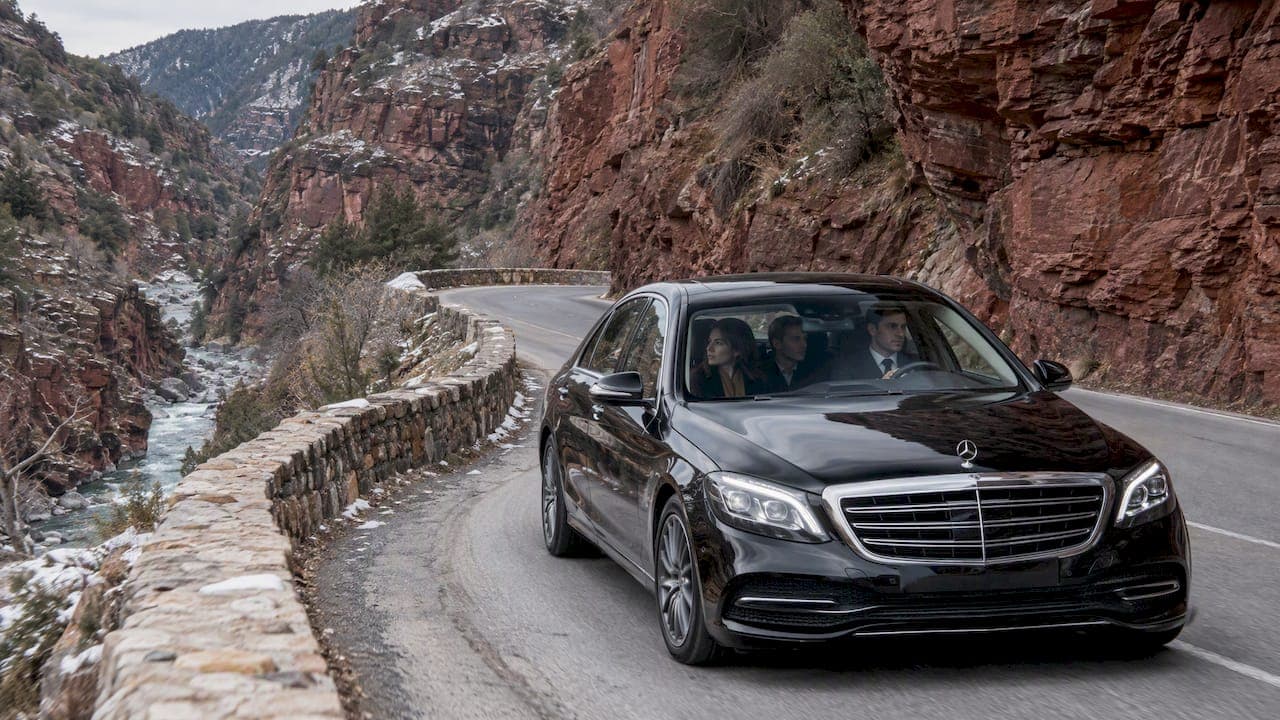
Valberg is reachable all year, but not by a single road. From Nice you leave the A8 at Exit 52 (Nice-Saint Isidore), join the D6202 towards Digne, and then choose between the D28 through the Cians gorges, the D2202 through the Daluis gorges via Guillaumes, or the M2205 over the Col de la Couillole, according to the resort itself. Conditions differ on each, and that choice is the whole story of Valberg road conditions: which of the three is the sensible one today.
This guide explains what each road is like, where to find the official status, what the rules from 1 November 2026 require of a car, and when it makes sense to hand the mountain to a professional driver. We run airport transfers to Valberg from Nice Côte d'Azur (NCE) at TranspOnyx, so some of what follows comes from the driver's seat.
Three roads, three characters
Nice Côte d'Azur International Airport is about 86 km from the resort, according to Valberg's access page. Plan on roughly two hours door to door in good conditions, more in snow or behind a slow lorry. The first stretch is the same for everyone: the motorway, then the D6202 up the Var valley. The mountain begins when you turn off it.
| Route | Road | What defines it |
|---|---|---|
| Cians gorges | D28 | Narrow, cut into red rock, spectacular and slow |
| Daluis gorges, via Guillaumes | D2202 | Dramatic gorge, then a gentler approach through Guillaumes |
| Col de la Couillole, via Roubion | M2205 | Highest of the three, most exposed in bad weather |
The resort's road information page describes the Cians and Daluis gorges as renowned for their narrow passages, while the Couillole route climbs higher and can be the most demanding when the weather turns. That matches what drivers who do this run regularly will tell you.
The Cians gorges (D28)
The D28 is the road people photograph. It clings to a canyon of deep red schist, with tight bends, short tunnels and sections where two vehicles pass with care. In dry weather and daylight it is a memorable drive. In heavy rain, falling stones are the concern, and in the dark the lack of margin is tiring even for experienced drivers. A rockfall can close it for days: a large slide on a road towards a Alpes-Maritimes ski resort in January 2025 left access possible only by detours that lengthened the journey, as local press reported at the time, which is a useful reminder that alternatives exist for exactly this reason.
The Daluis gorges (D2202)
The Daluis route is wider and more forgiving in its general character, though no less striking. It reaches Guillaumes, a proper village with services, before the final climb. Many drivers who dislike the Cians bends prefer this approach, particularly when arriving after dark. It adds distance, but not stress.
The Col de la Couillole (M2205)
The M2205 goes over a pass and then through Roubion. Altitude is the difference: it is the road most likely to show snow, ice or fog first, and the one where a shift in the forecast matters most. When the weather is settled it is a handsome, open road. When it is not, it is the first one we would rule out.
Where to check the status before you leave
The resort advises visitors to consult the Alpes-Maritimes road information to plan every trip, on its road information page. The departmental service publishes the day's road conditions, closed passes and roadworks on departmental roads, and in winter it is the authority that matters, since Valberg's three approaches are all departmental roads rather than motorway.
A sensible routine takes five minutes. Check the departmental report on the morning of travel, look at the resort's weather page for the forecast, and look at the snow conditions page for the state of the ski area. Then make the road choice at the D6202 junction, not at the airport car park. Information at a junction is better than information from yesterday.
Resort webcams are helpful for the village itself, but a camera in Valberg tells you nothing about the Couillole pass an hour earlier. Treat each road as its own question.
Autumn 2026: wet roads before the snow
We are writing in mid-October, and the pattern for the weeks ahead is rain rather than snow. Seasonal tendencies published in August point to a warmer than normal autumn with abundant rainfall in places. For mountain roads in the Alpes-Maritimes that means damp surfaces, leaf litter on shaded bends, low cloud in the gorges and the occasional fall of stones or mud after a heavy downpour.
None of this closes Valberg to ordinary traffic. It does change how you drive: lower speed into bends, more distance to the vehicle in front, dipped headlights in cloud, and a refusal to treat the D28 as a race track simply because it is only 'a small road'. Early snow at altitude is also possible before the winter rules begin, so a late-October trip should still be checked as carefully as a January one.
The winter equipment rule from 1 November 2026
Under the Loi Montagne II, winter equipment is required in the Alpes-Maritimes from 1 November to 31 March. The vehicle must carry either four approved 3PMSF winter tyres, or snow chains or textile snow socks for at least two drive wheels, according to reporting on the departments concerned. For 2026-27 that means the obligation begins on 1 November 2026 and runs to 31 March 2027.

In practice, this matters most to people hiring a car at the airport. A rental car with ordinary all-season tyres and nothing in the boot may be non-compliant on a signed mountain road, and chains that have never been fitted are hard to put on at the roadside in sleet. If you are unsure what the car carries, ask before you leave the rental desk. For visitors who would rather not take on that responsibility, a chauffeured vehicle removes the question altogether: the equipment is the driver's concern, not yours.
Driving yourself or taking the bus
Both are workable, and each suits a different traveller.
Self-drive
If you are comfortable on mountain roads, own or hire a suitably equipped car, and are arriving in daylight with clear weather, driving is perfectly reasonable. Allow generous time, fill the tank at the foot of the valley, and keep chains accessible rather than buried under luggage. After a long-haul flight, honestly assess how tired you are before choosing a gorge road in the evening.
Public transport
Regional bus line 670 links Nice Grand Arénas bus station with Valberg all year, with fares starting from €2.10 if bought in advance or €2.50 on board. In winter there is also Line 83, a ski bus by reservation only, priced at €6.00 for a single journey and requiring 12 hours' notice, according to the same page. It is the cheapest option by a wide margin, and for a solo traveller with light luggage and a flexible schedule it is a sound choice.
Its limits are the ones you would expect. Luggage, skis and children are awkward on a mountain bus, departure times are fixed, and the connection from the airport to the bus station is yours to arrange. A late flight can break the chain entirely. For groups, coach and minibus hire for larger parties is a further way to keep everyone together, though it is a different proposition from a private car for two or three people.
Why a private transfer suits these roads
The argument for a chauffeur is not luxury for its own sake. It is that the person at the wheel does this drive regularly, has seen each road in every season, and decides on the day which one to use. Our drivers are licensed VTC professionals, bilingual in English and French at the least, and they follow the departmental road reports and live traffic data rather than relying on a satnav's default. If the D28 is closed or unwise, the transfer goes by the D2202 or the M2205 without you having to renegotiate anything.
The practical benefits are modest but real. Your luggage and skis are handled for you. Flight monitoring is included on every airport transfer, so a delayed arrival at NCE does not cost you the booking, and we include 60 minutes of free waiting on airport pickups. The vehicle is a Mercedes-Benz with Wi-Fi, air conditioning, chilled water and phone chargers, and child seats are available on request.
Which vehicle
The Standard Sedan and the Business Sedan each take up to three passengers. The Business Sedan has the premium finish, a sensible choice for an executive arriving for a corporate event. Families or ski groups with equipment should look at the Van 7 pax or Van 8 pax, which have the room that skis, boots and suitcases demand. Tell us the number of people and the kit when you book and we will match the vehicle.
What the transfer costs in 2026
Our 2026 fixed rates are per vehicle, confirmed at booking, with no surge pricing. The published range for the transfer from Nice airport to Isola 2000, Auron and Valberg is 240 to 350 EUR per journey, depending on the vehicle and the circumstances of the trip. That is a rate for the car, not per person, which changes the arithmetic for a family of four or a group of seven compared with individual tickets.
For comparison, the same fixed-rate approach applies elsewhere on the coast. A transfer from NCE to Monaco is published at 90 to 140 EUR and to Cannes at 90 to 150 EUR, on our airport transfer page. If your trip combines the mountains with a few days at the coast, one provider can cover both legs.
For Valberg specifically, our Valberg transfer page gives the details. If you are weighing neighbouring resorts, we have also written about Nice to Auron transfers and getting to Isola 2000, two resorts reached by the same valley.

Our view from the road
We are asked about Valberg road conditions mostly in two seasons. In late autumn, people hear that the roads are 'dangerous' and imagine something worse than the truth. In the first heavy snowfall of winter, they imagine something better. Both instincts miss the point. These are well-engineered departmental roads that are open most days, kept clear by the département, and driven daily by locals. What they are not is forgiving of improvisation.
The real risk is a mismatch between the road, the vehicle, the weather and the driver's experience. A rested driver in a properly equipped car on the Daluis road in daylight has an easy morning. A tired visitor in a hire car with summer tyres on the Couillole in falling sleet does not. Our job is to remove that mismatch. We choose the road on the day, we look at the departmental information as we go, and we are comfortable telling a client that the sensible route is the longer one.
We also encourage honesty about timing. A flight that lands at 21:30 in January and a two-hour mountain drive is not a combination to hurry. If the conditions are poor, we would rather arrive late and calm than on time and tense, and we plan the booking around that from the start. Concierges and travel agents who book for guests tell us the same: the clients remember the arrival, not the saving.
— Dany
Booking a transfer to Valberg
If you would like a fixed 2026 rate for your arrival, send us your flight number, party size and luggage. We confirm the price at booking, monitor the flight, and meet you at NCE. Reservations are open 24 hours a day, seven days a week on +33 6 10 30 71 84, on WhatsApp at +33 7 67 78 10 26, or through TranspOnyx. For other Riviera journeys, our airport transfer service covers Monaco, Cannes, Antibes, Menton and Saint-Tropez.
Frequently asked questions
Is the road to Valberg open all year?
Yes, Valberg is accessible year-round from Nice, via the A8, the D6202 and one of three mountain roads. Individual roads can close after snow, ice or rockfall, which is why there are three. Check the departmental road information on the day you travel.
Which road to Valberg is best in winter?
There is no single answer, because it depends on that day's conditions. The Col de la Couillole (M2205) is the highest and most exposed, so it is usually the first to be avoided in poor weather. The Daluis route through Guillaumes is often the more comfortable choice, though a local driver will decide on the day.
Do I need snow chains or winter tyres for Valberg?
From 1 November 2026 to 31 March 2027, the Alpes-Maritimes requires either four 3PMSF winter tyres or snow chains or socks for at least two drive wheels. This applies to the vehicle, so check a hire car before you accept it. A chauffeured transfer takes care of the equipment for you.
How far is Valberg from Nice airport?
The distance is about 86 km. Allow around two hours in normal conditions, and longer in snow or heavy rain. Our drivers monitor your flight, so the pickup time adapts if the aircraft is late.
Can I reach Valberg by public transport?
Yes. Line 670 runs year-round from Nice Grand Arénas bus station, and in winter Line 83 operates by reservation only, with 12 hours' notice. Both are inexpensive, but fixed timetables and limited luggage space make them less practical for families and ski groups.