
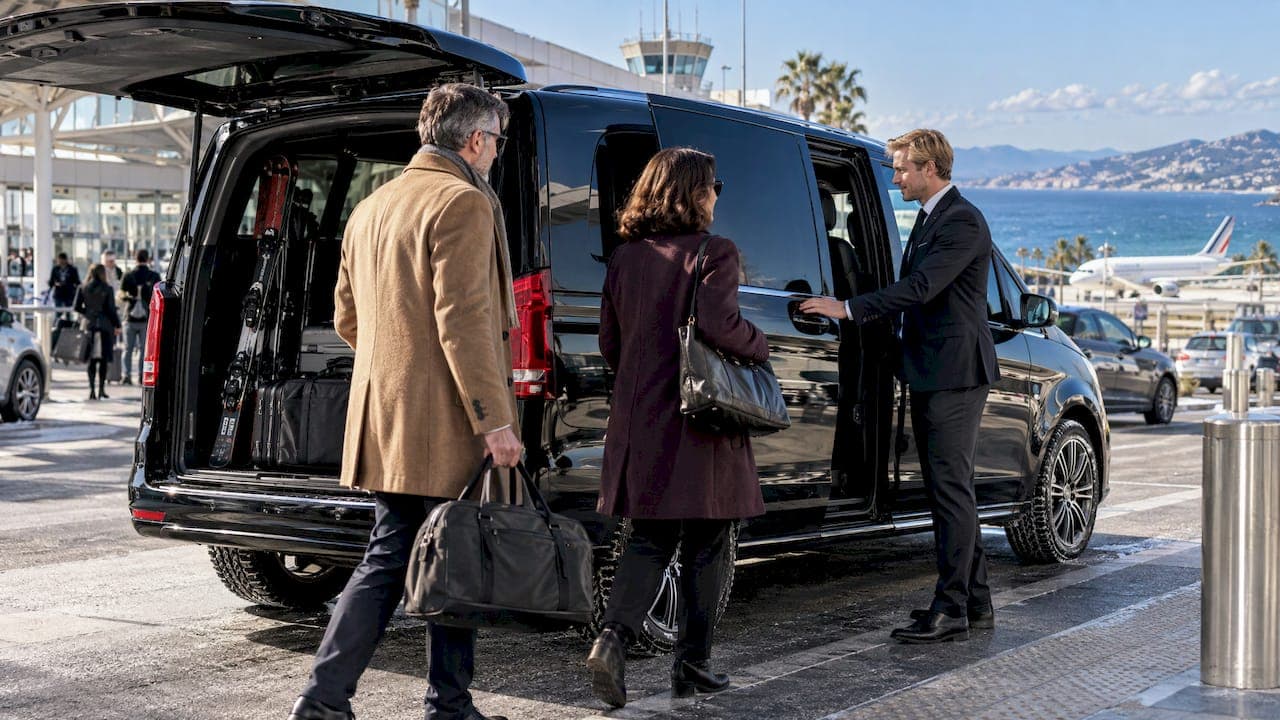
If you are driving into the Mercantour this winter, the rule is simple. From 1 November 2026 to 31 March 2027, in the mountain communes designated by prefectural order, your car must either carry removable anti-skid devices for at least two driven wheels or be fitted with four winter tyres, according to service-public.gouv.fr. Only tyres bearing the 3PMSF symbol count. Ordinary summer tyres do not, and neither do tyres marked M+S alone.
That is the legal picture. The practical one matters just as much: valleys above Nice can turn from dry to snow-covered within a single climb, and a car collected at Nice Côte d'Azur Airport (NCE) needs to be checked for the right equipment before you head up. At TranspOnyx we drive these roads for a living, so this guide covers the rule, the communes concerned, the equipment, the penalties and the alternative of letting a professional handle the mountain.
What the Loi Montagne requires from 1 November 2026
The Loi Montagne II obligation applies every winter between 1 November and 31 March. It covers communes named in prefectural orders in 34 departments, spread across the Alps, Corsica, the Massif Central, the Jura, the Pyrenees and the Vosges, again according to service-public.gouv.fr. The Mercantour sits within the Alpes-Maritimes (06) and, on its northern edge, the Alpes-de-Haute-Provence (04).
The rule applies to light vehicles, utility vehicles and motorhomes. You have two ways to comply:
- Carry removable anti-skid devices that fit at least two driven wheels. Metal chains are recommended for frequent use, textile snow socks for occasional use.
- Fit four winter tyres.
Note the phrase "carry". Having chains in the boot satisfies the text of the law even when the road is clear. What it does not do is help if you have never fitted them, which is why we return to practice further down.
The obligation is signalled on the road. A B58 sign marks the entry to a zone where winter equipment is mandatory, and a B59 sign marks its end, as the Ministry of the Interior explains. Treat those signs as the legal boundary on the day, whatever the weather looks like at your hotel on the coast.
Which Mercantour communes are covered
In the Alpes-Maritimes, 82 communes fall under the winter equipment obligation. The list published by France 3 Régions in November 2024 includes Beuil, La Brigue, La Bollène-Vésubie, Saint-Martin-Vésubie, Saint-Etienne-de-Tinée, Saint-Sauveur-sur-Tinée, Valdeblore, Guillaumes and Tende.
Those names correspond to the great Mercantour valleys: the Vésubie, the Tinée, the Haut Var and the Roya. Beuil and Guillaumes are the gateways to Valberg and the upper Var; Saint-Etienne-de-Tinée leads towards Auron and Isola 2000. If your destination is a ski resort in the valley of the Tinée or the Var, assume you are inside a regulated zone.
Because prefectural orders are renewed and can be amended, treat any list, including this one, as a guide. The order in force for the current season is the reference.
Do all-season tyres count?
Only if they carry the 3PMSF marking, the "three peak mountain snow flake": a mountain with three peaks and a snowflake inside. The symbol is the only guarantee of winter performance in all conditions, since it rests on a standardised European test of traction on snow or ice, as service-public.gouv.fr states. Only 3PMSF-marked tyres are accepted as equivalent to removable anti-skid devices.
To check your own set, look at the sidewall. If you see the snowflake inside the mountain pictogram, you are covered. If you see only M+S, the tyre does not meet the requirement and you should carry chains or socks as well. Remember that the requirement is for four winter tyres, not two, so a car shod with winter tyres on one axle only is not compliant on that basis alone.

Chains or snow socks: choosing and fitting
Both are lawful. Metal chains suit frequent mountain use and are the better choice if you will be climbing to resorts repeatedly during a stay. Textile socks suit an occasional, short exposure to snow, as the official guidance puts it.
The road-safety brochure published by the Sécurité routière adds several points worth remembering:
- Fit chains when the surface is snowy, even where no sign requires special equipment.
- Choose a flat area with room to work, and wear a reflective vest.
- Re-tighten the chains after a few kilometres.
- Do not drive on dry roads with chains: it damages the road, the chains and potentially the vehicle.
- Keep to 50 km/h at most with chains, increase your safety distances, and give priority to snowploughs and gritting lorries.
The Ministry of the Interior also advises rehearsing the fitting before you leave. Doing it for the first time on a hairpin at dusk, with cold hands, is a poor introduction. A trial in a car park takes minutes and removes most of the stress.
What happens if you are not equipped
The legal position is subtle and worth stating exactly. A fourth-class contravention, with a fixed fine of €135 and possible immobilisation of the vehicle, has been described, but the minister's reply to a Senate question says that sanctions require a decree. As of the 2025–2026 winter, that decree had not been published and the rule was applied in an educational way. Reporting for the coming season indicates the position remains the same for 2026–2027: no automatic fine, though officers can still refuse access to a designated zone to a vehicle that is not properly equipped.
Two consequences follow. First, a turned-back journey is a real cost, particularly if you have a flight, a dinner reservation or a conference session on the other side. Second, the same source notes that an insurer may reduce or refuse cover after an accident on a snowy road in a designated zone if the vehicle did not comply, because the missing equipment can be treated as negligence. Check the terms of your own policy or rental agreement before relying on either.

Reading the conditions before you leave
The Mercantour National Park asks visitors to check road accessibility and snow conditions before departure, to identify the roads they will take, and to consult Info Route for the Alpes-de-Haute-Provence and the Alpes-Maritimes, on its practical information page. The same page notes that the Col de la Bonette, at 2,800 m, is open only from mid-May to mid-September. In winter, reaching Barcelonnette often means going round via Digne-les-Bains and the Blanche valley.
For a wider view, Bison Futé's detailed forecasts list winter driving conditions, closures, restrictions and mandatory-equipment alerts on French roads. For weather, Météo-France's vigilance page for the Alpes-Maritimes is the one to open. Under orange vigilance for snow and ice, its advice is to equip the vehicle, carry food and blankets, and limit travel.
The mountains do deliver. Météo-France reported that the southern ranges, including the Mercantour, received substantial snowfall in late January and early February 2026: 10 to 80 cm in high valleys and lower stations, and 150 to 200 cm around 2,500 m. Such a spell is the reason the rule exists.
Planning a trip from the coast also means thinking about the whole itinerary, not only the mountain leg. A guide to winter travel ideas and route planning can help you decide how far you want to push the day before you commit to a drive.
Preparing the car
The Ministry of the Interior's winter checklist is short and sensible. Check the battery, as cold in February and March can cut its power by as much as 50%. Use washer fluid rated to -20°C. Check the fog lights and the wipers. Test the chains. All of this is described in its mountain-driving advice.
Fill the tank before leaving the coast, keep a warm layer and water in the car, and set off early enough that you are not climbing in the dark after a long flight. If a road looks doubtful, turning around is always cheaper than being recovered.
Our point of view on winter in the Mercantour
Every winter we see the same pattern. A visitor lands at NCE in sunshine, collects a car and heads for Auron, Isola 2000 or Valberg with a plan built around the weather on the Promenade des Anglais. An hour later the road is different, the light is going and the chains are still in their bag, if there are any at all.
We believe the sensible answer is to separate the two skills. Driving a fully rested, prepared vehicle on mountain roads in winter is a job, not a hobby, and our drivers are licensed VTC professionals who do it as part of their work. They are bilingual in English and French as a minimum, and they monitor your flight, so a delay never leaves you hunting for a car in the arrivals hall.
Our fleet is entirely Mercedes-Benz: Standard Sedan and Business Sedan for up to three passengers, Van 7 pax and Van 8 pax for larger groups with ski luggage. Each vehicle has Wi-Fi, air conditioning, chilled water and phone chargers, and child seats are available on request. Rates are fixed per vehicle and confirmed at booking, with no surge pricing, which matters most on the days when everybody wants to go up the mountain at once.
Our advice to anyone with a ski week ahead is to decide early whether they want to drive. If not, a chauffeur removes the equipment question, the fitting of chains and the navigation in a single booking. We would rather you arrived relaxed than arrived proud of having done it yourself.
Dany
Chauffeur transfers to the ski resorts
If you would rather not take the wheel, we run transfers from Nice Côte d'Azur Airport to the main Alpine resorts. Our 2026 fixed rate for the run to Isola 2000, Auron or Valberg is €240 to €350 per vehicle, one way, on the airport transfer page. The price is for the vehicle, not per person, so a family or group sharing a Van 7 pax or Van 8 pax divides it between them.
Destination-specific details are on our pages for Valberg, Auron and the luxury ski transfers from Nice Airport. Free waiting time is included: 60 minutes on airport pickups and 20 minutes at any other address.
Matching the vehicle to the group
A couple with two suitcases and one pair of skis each will be comfortable in a Standard Sedan. A Business Sedan carries the same three passengers with a premium finish, which suits a business traveller or a honeymoon. For a family of five or six with boots, bags and boards, the Van 7 pax is the sensible starting point, and the Van 8 pax is for a full party of eight. Tell us the luggage when you book, and ask for child seats at the same time.
A worked example: a ski weekend from Nice
Take a family of five landing at NCE on a Friday evening in February, bound for Auron. Driving themselves, they would need to confirm that the hire car has four 3PMSF tyres or chains for two driven wheels, fit those chains if the road demands it, keep to 50 km/h while wearing them, and do all of that after a flight, with children and luggage, as night falls. Insurance terms, as noted above, depend on being compliant in a designated zone.
By chauffeur, the same family walks out of arrivals to a driver who has followed the flight, loads the bags into a Van 7 pax and handles the climb. With a fixed rate of €240 to €350 per vehicle for Isola 2000, Auron or Valberg, the cost is known at booking, then split across the group. The 60 minutes of free waiting on airport pickups also absorbs the usual delays at baggage reclaim.
Planning around events and travel peaks
The Riviera does not empty in winter. Business travellers and delegates move between Nice, Cannes and Monaco around MIPIM in March, and the calendar fills again with MIPCOM, Cannes Lions, the Cannes Film Festival and the Monaco Grand Prix across the year. If a mountain day is part of a longer stay, book the transfer and the coast journeys together so that vehicles and drivers are confirmed in advance. Check the official sites of each event for current dates, as they change from one edition to the next.
Coast journeys the same season
Winter is also the season for events and short breaks on the coast, where no mountain equipment is needed at all. Our 2026 fixed airport rates run from €68 to €110 for Antibes and Juan-les-Pins, €90 to €140 for Monaco and Monte-Carlo, €90 to €150 for Cannes and €108 to €158 for Menton and Beausoleil, all per vehicle. The Nice to Cannes city run is €75 to €110. Saint-Tropez and Ramatuelle are €260 to €400.
Journeys to Monaco have their own rules, so our guide to Monaco circulation restrictions is worth reading before a Grand Prix or business visit. For delegates travelling to MIPIM, Cannes Lions or MIPCOM, our corporate chauffeur service on the French Riviera covers multi-vehicle coordination. If you want to stay connected on the road, we explain how Wi-Fi works in our vehicles.
For a day exploring rather than a point-to-point run, we offer by-the-hour hire from €60 to €90 per hour, and private excursions through Onyx Tours: a five-hour half day from €350 to €500, or a nine-hour full day from €630 to €900, on the Onyx Tours page.
Book a chauffeur for the mountain
Whether you are heading to a resort for the weekend or to a conference in Cannes, we confirm the fixed price at booking and monitor your flight. Reserve through transponyx.com or call our reservations line on +33 6 10 30 71 84. WhatsApp is +33 7 67 78 10 26, and we operate 24 hours a day, seven days a week.
Our airport transfer rates are listed on the Nice airport transfer page, and the page for premium transport around the Côte d'Azur shows how the rest of our service fits together.
Frequently asked questions
Are snow tyres compulsory in the Mercantour?
In the designated communes, between 1 November and 31 March, you must either fit four winter tyres or carry removable anti-skid devices for at least two driven wheels. Four-season tyres qualify only with the 3PMSF marking. Signs B58 and B59 mark the start and end of each regulated zone.
Can I be fined for not having winter equipment?
The text describes a €135 fixed fine, but the Ministry of the Interior's reply to the Senate says a decree is needed before it can be applied, and none had been published during winter 2025–2026. Officers can still refuse entry to a zone, and an insurer may question cover after an accident. Check the current position before travelling.
How do I know whether my all-season tyres are 3PMSF?
Look at the sidewall for a mountain pictogram with three peaks and a snowflake inside. M+S on its own is not enough. If the symbol is missing, carry chains or snow socks.
Where can I check mountain road conditions?
Use Info Route for the Alpes-Maritimes and the Alpes-de-Haute-Provence, as the Mercantour National Park recommends, plus Bison Futé for closures and equipment alerts and Météo-France vigilance for snow and ice warnings.
Can TranspOnyx take me to Isola 2000, Auron or Valberg from Nice airport?
Yes. Our 2026 fixed rate is €240 to €350 per vehicle, confirmed at booking. You can reserve on our website or by phone on +33 6 10 30 71 84.
Sources
- Service-public.gouv.fr: winter tyres and chains, Loi Montagne
- Ministry of the Interior: mountain driving in winter
- France 3 Régions: Alpes-Maritimes communes concerned
- Sénat: question on winter equipment obligations
- Leocare: Loi Montagne 2026–2027
- Mercantour National Park: getting there
- Bison Futé: detailed forecasts
- Météo-France: vigilance Alpes-Maritimes
- Météo-France: snowy massifs