
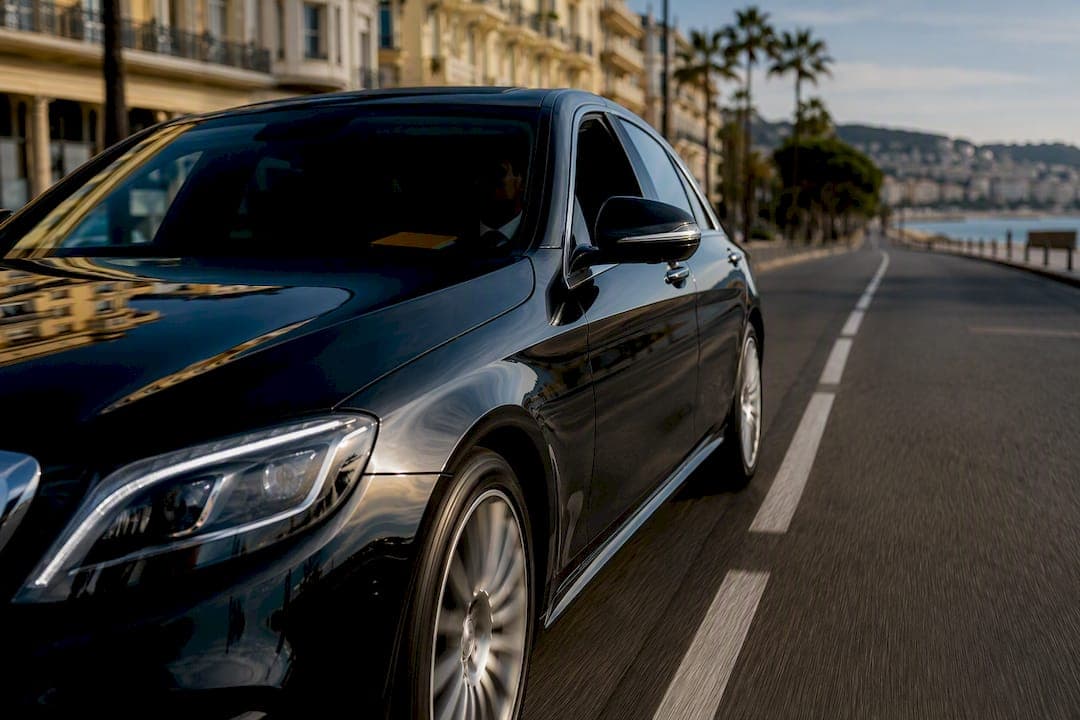
Yes, Nice operates a low emission zone, the ZFE-m, active since 2022 across the Promenade des Anglais and the hypercentre. Following the 2024–2025 regulatory easing, restrictions in 2026 target heavy goods vehicles and coaches rated Crit'Air 4 or 5, not ordinary passenger cars. Check your vehicle's classification on Certificat-air before arrival and order a Crit'Air vignette if the tool flags you.
Where does the Nice low emission zone actually run?
The ZFE-m perimeter is not the whole city. It follows a defined set of axes that the Métropole Nice Côte d'Azur publishes and updates through official arrêtés, and knowing the exact line matters more than knowing the zone exists.
The zone runs the length of the Promenade des Anglais, along the seafront quays of Quai des États-Unis and Quai Rauba Capéu, and through a defined slice of the hypercentre. Roads running parallel a few streets back, further inland from the seafront corridor, typically sit outside the restricted perimeter, which is why two roads a hundred metres apart can carry different rules.
The principal axes to watch include:
- The full seafront run from the airport end of the Promenade des Anglais to Rauba Capéu, at the eastern edge of the Baie des Anges.
- Quai des États-Unis, connecting the promenade to the old town.
- Sections of the hypercentre bounded by specific cross streets, rather than the district as a whole.
- Roads explicitly excluded at the boundary, which official maps mark distinctly from restricted axes.
Guessing the boundary from memory is a poor strategy. The Métropole publishes open geojson datasets covering both the restricted roads (voies) and zones (aires), which developers and navigation apps can ingest directly. For a visual check before you drive, the municipal interactive map viewer shows the same axis layers with a legend, letting you zoom to street level and confirm whether your route crosses a restricted stretch.
Who is actually restricted in 2026, and how did we get here?
Nice's ZFE has moved through three distinct phases since launch, and the vehicle categories affected have narrowed each time, not widened, which surprises many drivers expecting stricter rules with each passing year.
- 2022: introduction. The ZFE-m launched with initial restrictions targeting the oldest, highest-emitting vehicles across both goods and passenger categories.
- 2023 to 2024: tightening. Enforcement extended to cover additional Crit'Air bands, with passenger cars rated Crit'Air 4 and 5 facing restrictions on the core axes during this period.
- 2025: the easing. A new municipal arrêté narrowed the operational scope. By April 2025, the Métropole confirmed that most passenger cars were no longer restricted, with enforcement refocused on heavy goods vehicles, buses and coaches rated Crit'Air 4, 5 or unclassed.
- 2026: current scope. Heavy vehicles and coaches without an adequate Crit'Air rating remain banned from the zone; private cars, including older diesels in many cases, generally circulate freely, though checking your own classification remains the only way to be certain.
Local authorities deliberately narrowed the scope rather than expanding it, choosing to concentrate enforcement on the vehicles responsible for the largest share of urban emissions. Two wheeled vehicles, refuse collection vehicles and holders of mobility inclusion cards sit outside the restricted categories entirely. For anyone driving a rental or a foreign-registered vehicle, the practical implication is straightforward: if you are behind the wheel of a car rather than a coach or lorry, the 2026 rules rarely affect you, but heavy vehicle operators need to check every time.
Which Crit'Air sticker do you need, and how do you get one?
The Crit'Air vignette is a coloured windscreen sticker that classifies your vehicle by emissions, from Crit'Air 0 for electric vehicles through to Crit'Air 5 for the oldest diesels, and it is this classification, not your registration paperwork, that determines whether you can enter a restricted zone.
Ordering one takes minutes:
- Visit certificat-air.gouv.fr, the sole official government portal for Crit'Air.
- Enter your registration details to receive an instant classification.
- Pay the modest administrative fee to have the physical sticker posted to you.
- Keep the confirmation email as proof of order while the sticker is in transit.
Delivery within France typically takes a week or two, longer if you order from abroad, so applying well before a trip to Nice avoids any awkwardness. If you are hiring a car at Nice Côte d'Azur Airport and the vehicle does not yet carry a valid sticker, the safest course is to confirm with the rental company that a vignette is displayed, or order one yourself using the car's registration details before you collect the keys. Given that heavy vehicles are the current enforcement priority, most tourists driving a hire car will not need to worry about a ban, but anyone crossing into France with an older diesel car or van should still check their classification rather than assume.
What happens if you enter the zone without complying?
Enforcement relies primarily on automatic number plate recognition cameras positioned along the restricted axes, backed up by manual police checks, particularly during high traffic periods.
Fines follow a tiered structure set out in national guidance. Penalties escalate for repeat or aggravated cases, and for heavier vehicles the amounts rise further, reflecting the government's guidance on Crit'Air enforcement. A fixed penalty notice typically arrives by post weeks after an ANPR camera logs a non-compliant plate, since checks are rarely made at the roadside for passenger cars.
Permanent exemptions cover a defined list of vehicle types:
- Vehicles displaying a mobility inclusion card for disabled drivers or passengers.
- Registered historic vehicles, generally those over 30 years old.
- Emergency services, including police, fire and ambulance vehicles.
- Waste collection and certain municipal service vehicles.
Temporary derogations exist for specific circumstances, such as event logistics, and drivers who believe a fine was issued in error can contest it through the standard national appeals process referenced on the service-public.fr guidance. Given that enforcement now concentrates on heavy vehicles, private car drivers face far less exposure than they did before 2025, though a lorry or coach operator ignoring the rules faces a genuinely costly outcome.
Why professional chauffeur services remove the compliance guesswork
Fleet operators solve the classification question before a passenger ever gets in the car. Every vehicle carries the correct rating, every route through the ZFE is planned in advance, and the driver, not the guest, carries the risk of getting it wrong.
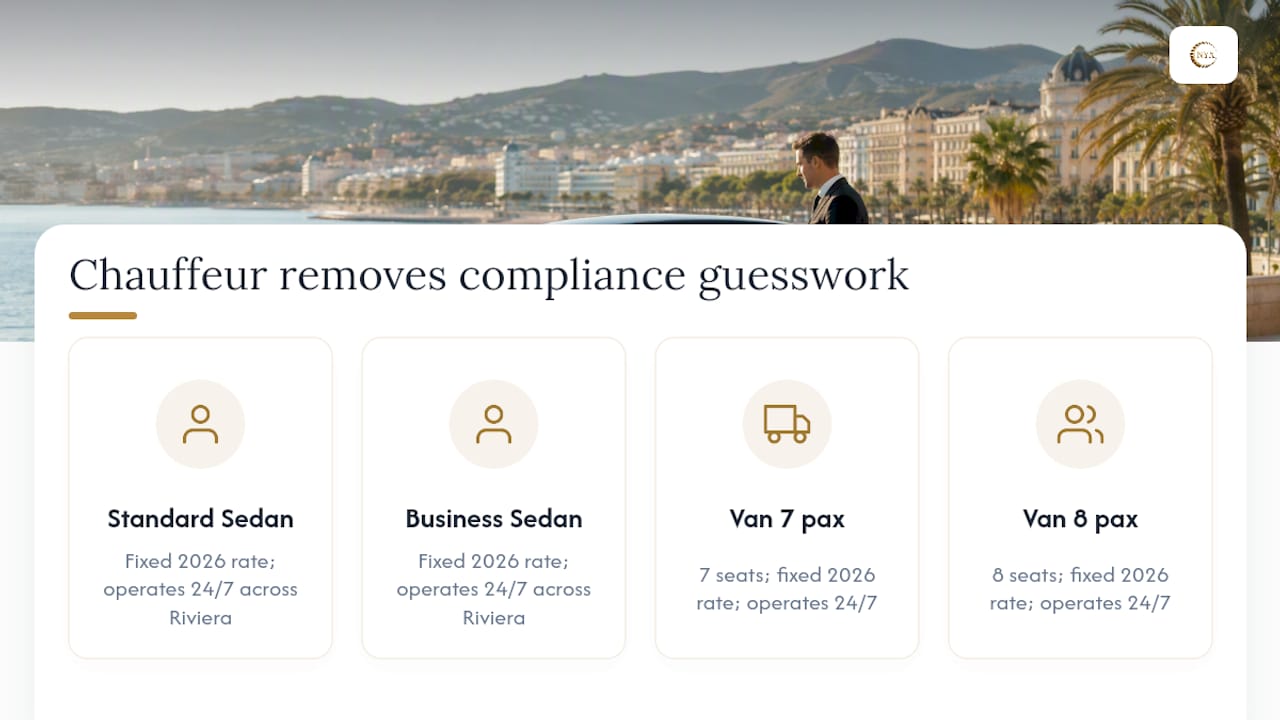
Transponyx runs a Mercedes-Benz fleet across four categories, Standard Sedan, Business Sedan, Van 7 pax and Van 8 pax, on fixed 2026 rates, operating 24 hours a day across the Riviera. For an airport transfer landing at Nice NCE during the Cannes Film Festival or the Monaco Grand Prix, when traffic pressure through the hypercentre peaks, that certainty is worth more than the small saving of self-drive.
An honest word on planning your own route through Nice
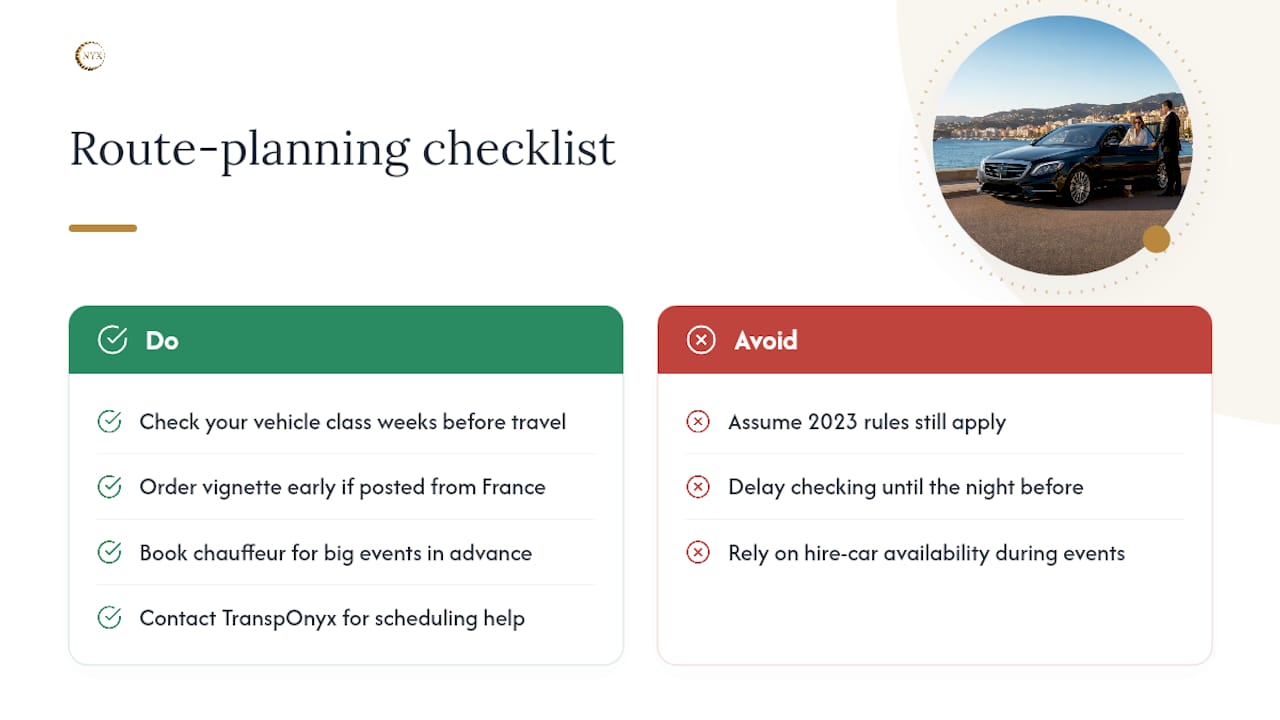
Most drivers overthink the Nice low emission zone in 2026. The heavy easing since 2025 means the average tourist in a hire car has almost nothing to fear from the ZFE itself; the real risk sits with anyone driving an older van, minibus or coach who assumes the old 2023 rules still apply.
My advice is dull but reliable: check your classification on certificat-air.gouv.fr weeks before you travel, not the night before, because a vignette posted from France can take longer to arrive abroad than most people expect. If your trip coincides with the Monaco Grand Prix, MIPIM, Cannes Lions or MIPCOM, when hire car availability tightens and hypercentre traffic slows to a crawl, booking a chauffeur-driven transfer in advance saves more stress than the compliance question ever will. TranspOnyx can be reached on +33 6 10 30 71 84 for exactly this kind of scheduling problem.
— Dany
A managed alternative to handling Crit'Air logistics yourself
Transponyx removes the Crit'Air question entirely for anyone who would rather not manage vehicle classification, sticker delivery and route planning around Nice's restricted axes. Every Mercedes-Benz in the fleet, whether a Standard Sedan, Business Sedan, Van 7 pax or Van 8 pax, is compliance ready and driven by a bilingual professional who already knows which quays and hypercentre streets to route around.
That matters most when the calendar is against you. Airport arrivals during the Monaco Grand Prix, delegate transfers for MIPIM, or a group heading to a Cannes Lions dinner all share the same risk: a self-driven hire car caught out by traffic, parking or an unfamiliar restriction. Fixed 2026 rates on every route from Nice NCE to Monaco, Cannes, Antibes, Menton or Saint-Tropez mean the price is confirmed before you travel, with no surprises added at the roadside. Flight monitoring and 60 minutes of free waiting time come standard on every airport transfer.
For a full breakdown of how private transfers work across the Riviera and what fixed pricing actually includes, the 2026 Riviera transfer guide is worth a read before you book. To arrange a transfer, call +33 6 10 30 71 84, WhatsApp +33 7 67 78 10 26, or visit Transponyx to check availability for your dates.
Sources
- Zone à Faibles Emissions - Métropole Nice Côte d'Azur
- Data
- Certificat-air
- Service-public guidance on Crit'Air and low-emission zones
- Cartes
FAQ
What happens if you drive through a low emission zone in France without the right sticker?
You risk an automatic fine triggered by ANPR cameras, with amounts escalating for heavier vehicles and repeat offences, as set out in national guidance.
Do tourists need Crit'Air stickers in Nice?
Tourists driving vehicles currently restricted, mainly heavy goods vehicles and coaches, need a valid Crit'Air sticker; most passenger car drivers are unaffected following the 2025 easing, but checking on certificat-air.gouv.fr removes any doubt.
Can I drive in France if my Crit'Air sticker hasn't arrived yet?
Keep your order confirmation as proof of purchase while the physical sticker is in transit, and avoid restricted axes in the meantime if your vehicle falls into a currently banned category.
Which cities in France have a low emission zone?
Nice is one of several French cities operating a ZFE, alongside other major urban areas, each with its own perimeter, timeline and vehicle categories, so always check the specific municipal page for the city you are visiting.
Does Transponyx handle Crit'Air compliance for passengers?
Yes. Every vehicle in the Transponyx fleet, from the Standard Sedan to the Van 8 pax, is compliance ready for the current ZFE rules, so passengers on airport transfers or event journeys never need to check a classification themselves.