

A mise à disposition chauffeur puts a professional driver and vehicle at your exclusive use for a fixed block of time, typically a few hours or more, rather than a single point-to-point trip. It suits multi-stop business days, weddings, events and airport work where waiting and flexibility matter more than a flat fare. If your itinerary has more than one destination, request a quotation before you compare it against ordinary VTC rates.
What does mise à disposition chauffeur actually include?
Mise à disposition means the chauffeur and vehicle stay with you for the duration you book, moving between as many stops as your schedule requires within that window. This is the essential difference from a standard VTC booking, which charges per journey between a fixed pickup and drop-off point. Book a driver by the hour or day and the meter, so to speak, does not reset every time you get back in the car. A French industry explainer on mise à disposition as a fixed-rate service describes exactly this arrangement: a vehicle and driver hired for a set duration, from a few hours to several days, with the chauffeur remaining at the client's disposal throughout.
Self-drive rental sits at the other end of the spectrum entirely. You get a car, you get insurance paperwork, and you get the parking headache in Monaco or Cannes during festival season. Mise à disposition removes all of that: the chauffeur handles navigation, parking, waiting and vehicle logistics while you focus on the meeting, the event, or simply the view along the Promenade des Anglais.
What is usually bundled into the rate:
- The chauffeur's time for the full booked duration, including driving between stops.
- Fuel and standard road tolls within the agreed itinerary.
- A specified allowance of kilometres per hour booked, plus a portion of waiting time between stops.
- Vehicle insurance and the driver's professional liability cover.
What tends to sit outside the base rate:
- Kilometres beyond the included allowance, usually billed per extra kilometre.
- Time beyond the booked block, charged as overtime at the hourly rate.
- Parking fees at certain venues, and sometimes motorway tolls on long-distance legs.
Fixed hourly or daily rates work better than metered pricing whenever a journey involves several stops, unpredictable waiting, or a schedule that might shift on the day. A wedding morning with three venue changes, or a corporate itinerary bouncing between a hotel, a conference centre and a client dinner, is precisely the scenario where per-trip VTC pricing becomes unpredictable and mise à disposition becomes the sensible option. Some providers also frame this as a flexible alternative for firms managing occasional transport needs without running their own vehicle fleet, which is worth noting if you are a travel manager weighing options.
When do people actually book a chauffeur by the hour on the Riviera?
Private clients reach for mise à disposition most often around events with a fixed structure but an unpredictable timeline. A wedding party moving from a villa in the hills above Cannes to a ceremony in Antibes, then on to a reception venue, needs a driver who waits rather than one who drops off and leaves. Shopping trips along the Croisette, villa guest transfers for a weekend party, and open-ended sightseeing around Cannes and Antibes all follow the same logic: the itinerary is fluid, so the pricing needs to be too.

Business use tends to cluster around the Riviera's calendar of major events. During the Cannes Film Festival, delegates often need a car and driver held for an entire day, shuttling between screenings, the Palais des Festivals and evening receptions with little advance notice of timing changes. MIPIM in Cannes and MIPCOM later in the year bring the same pattern for property and media executives moving between conference halls and client meetings. The Monaco Grand Prix compresses transport demand into a few frantic days, when road closures around the harbour make a chauffeur who knows the diversions far more valuable than a self-driven hire car. Cannes Lions adds a further layer of agencies and marketing teams needing reliable multi-stop transport between venues along the bay.
Typical scenarios worth booking mise à disposition for:
- Multi-venue business meetings across Nice, Cannes or Monaco in a single day.
- Wedding and private event logistics with several pickup points.
- Festival and conference attendance where schedules shift hour to hour.
- Combined airport arrival plus a half-day of sightseeing or client visits.
Airport and intercity work also benefits from the same held-driver model, particularly on the Nice NCE to Monaco corridor, Nice to Cannes, or transfers out to Menton near the Italian border. Booking a chauffeur for a half-day around a flight, rather than a single transfer, lets you fold in a stop at a hotel or a first meeting without a second booking. Providers that build in free waiting time and flight monitoring, standard on airport pickups, cut the risk of a delayed landing turning into a missed connection. For a broader look at how event transport is arranged around the Riviera calendar, see why chauffeur service suits Riviera events.
How much does a chauffeur by the hour cost in France?
Expect hourly rates to scale with vehicle category, and daily rates to offer a meaningful discount over booking the same hours individually. French VTC operators typically publish sample price tables for both hourly and full-day mise à disposition, and many calculate the kilometre allowance based on hours reserved, with Île-de-France examples commonly including around 20 kilometres per hour booked. On the Riviera, where distances between Nice, Cannes and Monaco are shorter than in Paris, that allowance tends to cover a normal multi-stop day comfortably.
Sample pricing structure — Several French chauffeur operators publish fixed price examples for 6-hour and 12-hour blocks, explicitly to help clients compare offers before booking. This transparency matters more in mise à disposition than in single-trip VTC, because the range of possible inclusions is wider.
Berline-class vehicles sit at the lower end of the pricing scale, business-class saloons cost more per hour for the added finish and space, and vans for group transport are priced by seating capacity and vehicle size. A fixed 6-hour or 12-hour rate is common practice among French operators, and asking for that structure upfront, rather than an open hourly meter, is the single easiest way to avoid an inflated final bill. For 2026, Transponyx confirms all rates per vehicle at the point of booking, with no surge pricing applied regardless of demand around events such as the Monaco Grand Prix or the Cannes Film Festival.
What a reliable quote should specify in writing:
- The vehicle category and confirmed passenger capacity.
- Kilometres included per hour or per day, and the rate for kilometres beyond that allowance.
- Waiting time included, and how any excess waiting is charged.
- The overtime rate if your day runs past the booked block.
- Whether fuel, tolls and parking are bundled or billed separately.
Most disputes over a mise à disposition bill trace back to two things: kilometres and overtime. Providers commonly bill extra kilometres per unit beyond the included allowance, and overtime at a simple multiple of the hourly rate, but the practical checklist worth confirming before booking includes included kilometres, waiting allowances and overtime rates explicitly, in writing, not verbally at pickup. Treat the kilometre allowance as the number that matters more than the headline hourly rate. A cheaper hourly price with a thin kilometre allowance can end up costing more once a driver crosses from Nice to Saint-Tropez, roughly two hours each way, than a slightly higher rate with generous mileage built in.
How do you book a chauffeur and what happens on the day?
Booking a mise à disposition chauffeur runs more smoothly when you have the full itinerary ready before you call, rather than trying to build it during the conversation. A precise quotation depends on the same handful of details every time.
- Confirm the date, start time and total duration you need the vehicle held for.
- List every stop, or at least the general area, so the driver can plan routing and estimate kilometres.
- Specify the vehicle category needed, based on passenger count and luggage.
- Provide flight numbers for any airport leg, so monitoring can be activated against delays.
- Ask for the quote in writing, covering kilometres included, waiting allowance and overtime rate.
Lead time matters more than most first-time bookers expect. During the Cannes Film Festival, MIPIM or the Monaco Grand Prix, demand for vans and business-class vehicles rises sharply across the whole Riviera. Last-minute requests often mean settling for a smaller vehicle than planned. Booking weeks ahead of these dates, rather than days, secures both the vehicle category you want and the driver continuity that makes a multi-stop day run smoothly. Guidance on securing reliable transport during peak Riviera periods covers this timing question in more detail.
Once confirmed, expect a booking reference, the driver's contact details, and confirmation of pickup location ahead of the day itself. If your schedule slips, most operators allow the block to extend on the spot, billed at the pre-agreed overtime rate rather than renegotiated on the roadside. Before signing off on any quote, check the cancellation window stated in the terms: shorter notice periods close to major events typically carry stricter refund conditions than routine bookings.
Pro Tip: Ask specifically whether the quoted kilometre allowance is per hour or fixed for the whole booking. A per-hour allowance on a 12-hour day adds up fast, but a flat allowance on the same booking can run short if your stops are spread between Cannes and Saint-Tropez.
How does TranspOnyx structure its mise à disposition service?
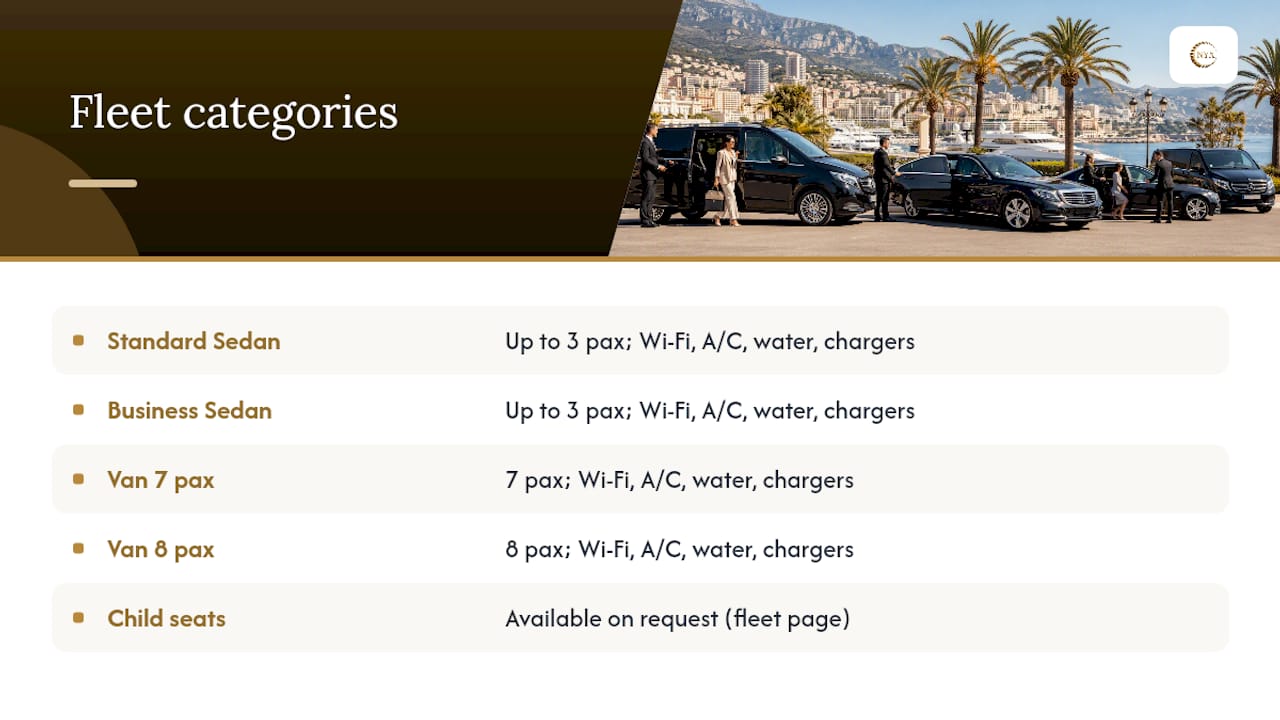
Transponyx runs its by-the-hour and by-the-day hire exclusively on a Mercedes-Benz fleet across four categories: Standard Sedan and Business Sedan, each seating up to three passengers, plus Van 7 pax and Van 8 pax for group transport. Every vehicle carries Wi-Fi, air conditioning, chilled water and phone chargers as standard, with child seats available on request, details also set out on the fleet page.
Primary routes cover the corridor most Riviera visitors and business travellers actually need: Nice Côte d'Azur Airport to Monaco takes roughly 25 to 35 minutes depending on traffic through the Moyenne Corniche, Nice to Cannes runs 35 to 55 minutes, and Cannes to Antibes is a short 25-minute hop. Menton, near the Italian border, and Saint-Tropez further west are both served as standard routes, alongside long-distance transfers into Italy toward Ventimiglia, San Remo and Milan, and up into the Alps for ski transfers to Isola 2000, Auron and Valberg.
All 2026 rates at Transponyx are fixed per vehicle and confirmed at the point of booking, with no surge pricing applied during high-demand periods such as the Monaco Grand Prix or the Cannes Film Festival. Free waiting time is built into every booking: 60 minutes on airport pickups and 20 minutes at any other address, with flight monitoring included automatically on every airport transfer.
Drivers hold VTC professional licensing and are bilingual in English and French at minimum, with some also speaking Italian, Spanish, Russian or Arabic depending on the booking. The service operates 24 hours a day, seven days a week, which matters for early morning festival departures or late arrivals from long-haul connections at Nice airport.
Booking channels are straightforward: call Transponyx directly on +33 6 10 30 71 84, message via WhatsApp on +33 7 67 78 10 26, or book through Transponyx. For sightseeing-style mise à disposition around Cannes and Antibes specifically, the private sightseeing tours page sets out how the same held-driver model applies to leisure days rather than business ones.
Why do so many first-time bookers overpay without realising it?
The mistake most people make with mise à disposition is comparing headline hourly rates without asking what kilometre allowance sits behind them. A lower rate with a thin allowance almost always ends up costing more once a real itinerary, say a morning meeting in Nice followed by an afternoon in Monaco, eats through the included distance and tips into per-kilometre overage charges.
Conventional advice tells readers to "get several quotes and compare." That is incomplete. The number worth comparing is not the hourly figure at all. It is the combination of kilometres included, waiting allowance and overtime rate, because those three variables determine what a genuinely busy day actually costs. A festival week itinerary bouncing between the Palais des Festivals and three separate receptions will expose a stingy allowance within hours.
Readers should prioritise getting a written quote covering all three variables before comparing price at all. Anyone treating hourly rate as the only decision point is pricing the wrong thing.
— Dany
Book a mise à disposition chauffeur with fixed 2026 rates
Transponyx gives you exactly what the checklist in this guide asks for: a written quote with kilometres, waiting allowance and overtime rate fixed before you travel, not negotiated at the roadside. Every 2026 rate is confirmed per vehicle at booking, with no surge pricing during the Cannes Film Festival, MIPIM or the Monaco Grand Prix, when other operators quietly raise theirs.
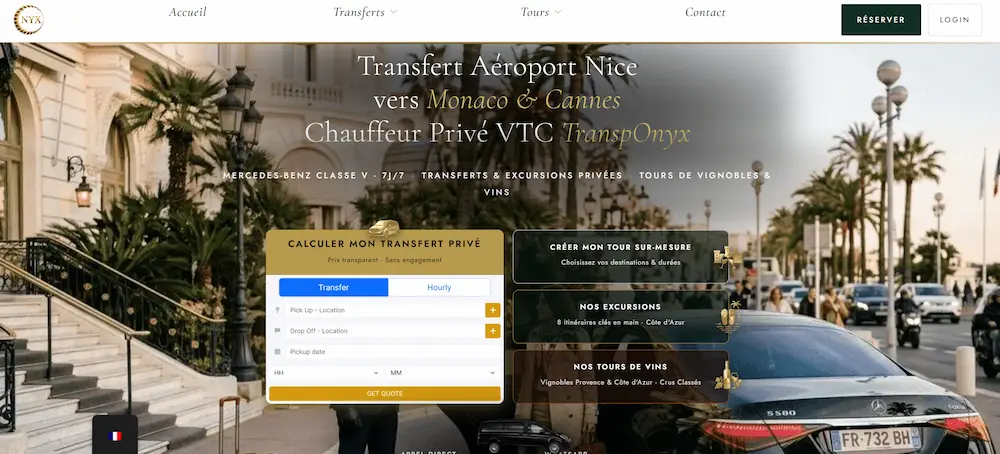
The Mercedes-Benz fleet, Standard Sedan, Business Sedan, Van 7 pax and Van 8 pax, covers everything from a solo business day between Nice and Monaco to a full wedding party moving between Antibes and Cannes. Bilingual VTC drivers, 60 minutes of free waiting on airport pickups, and flight monitoring on every transfer mean the details that usually cause disputes are settled before you get in the car. For corporate travel buyers weighing options against managing an internal fleet, the case for a held chauffeur is set out fully on the corporate account page, and the practical case for convenience in business travel more broadly is explored in this look at business travel priorities.
Call +33 6 10 30 71 84, message WhatsApp on +33 7 67 78 10 26, or request a fixed 2026 quotation directly through the airport transfer booking page for your next multi-stop day on the Riviera.
Sources
- Service mise à disposition : qu'est-ce que c'est ? | SRT Course
- Mise à disposition chauffeur VTC d'une heure à plusieurs jours
- Mise à disposition VTC - Service Chauffeur - Drivigo
- Qu'est-ce que la mise à disposition ? - SB Drivers
FAQ
What does "mise à disposition conducteur routier" mean?
It refers to a professional driver being placed at a client's disposal for a set period rather than a single trip, the same principle behind chauffeur-by-the-hour hire, whether for freight, logistics or passenger transport.
What are the rules for mise à disposition of a company vehicle?
Regulations vary by context, but for passenger chauffeur services the vehicle, driver licensing and insurance remain the operator's responsibility throughout the booked period, and the terms of kilometres, waiting time and overtime should be set out in the written quote before travel.
What counts as "availability" in road transport?
Availability describes the period during which a driver and vehicle are held ready for the client's use, including time spent waiting between stops rather than only time spent actively driving, which is exactly the basis on which mise à disposition is priced.
What is a vehicle mise à disposition contract?
It is the written agreement confirming the vehicle category, duration, included kilometres, waiting allowance and overtime rate for a chauffeur-driven hire, and providers such as Transponyx confirm these terms per vehicle before the booking is finalised.
What is the minimum booking duration for a chauffeur by the hour?
Minimums commonly range from two to three hours among French operators, with any time booked beyond that block charged at the standard hourly overtime rate.