
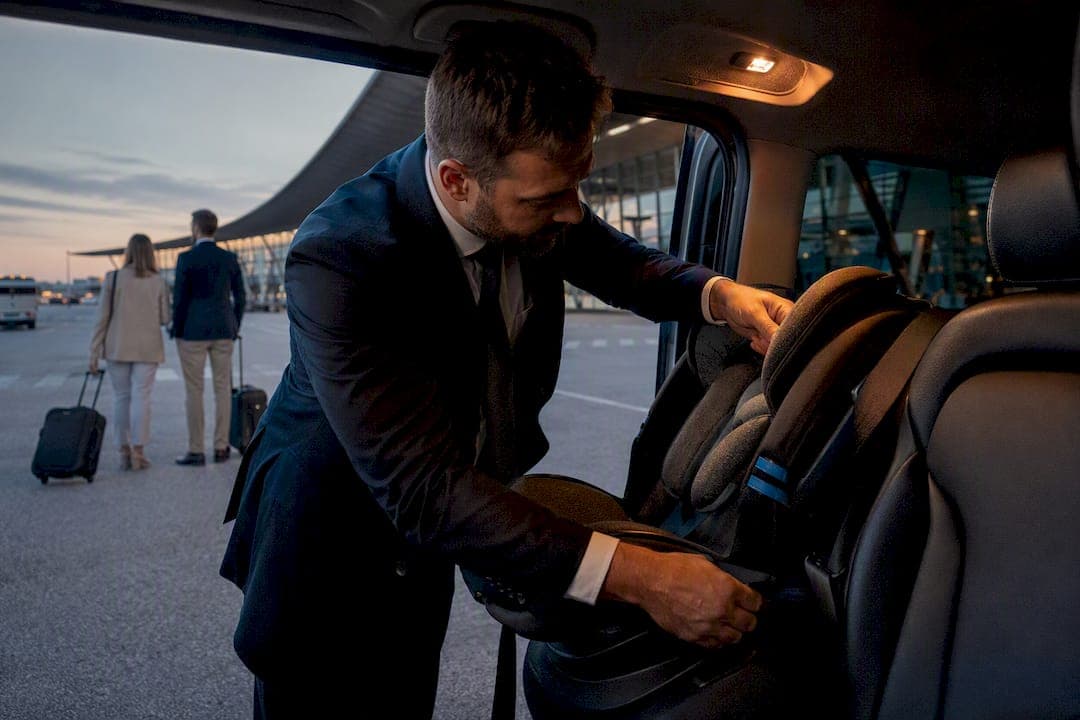
Under the French Highway Code, a child under 10 must travel in an approved restraint system suited to their height and weight, and a VTC driver who arrives without one can lawfully refuse the trip. Taxis carry a narrow historic exemption that VTCs do not share. The safest choice, regardless of vehicle type, is always a homologated seat that fits the child correctly, as Sécurité routière recommends without exception.
The child seat law for VTC bookings: what article R412-2 actually requires
The statutory basis for all of this sits in Article R412-2 of the Code de la route, which ties the obligation to the child's morphology rather than to a fixed age cutoff. In practice, that means the law cares about how tall and how heavy your child is, not just how old they are on paper. A large seven-year-old and a small nine-year-old may need different equipment even though both fall under the same age threshold.
The text requires that any child under 10 travelling in a private vehicle, including a hired VTC, be secured in a restraint system homologated to one of two European standards. Service-public's guidance on transporting a child by car confirms this and sets out the practical consequences for drivers and parents alike.
- The seat must carry an i-Size (R129) or ECE R44/04 approval label, visible on the shell or the fabric tag.
- The restraint must match the child's current height or weight bracket, not a bracket they have outgrown or not yet reached.
- The obligation applies to the driver as much as the parent. A professional driver who knowingly carries an unrestrained child under 10 shares the liability.
- Booster cushions without a backrest remain legal above certain height thresholds but are considered a minimum, not a recommendation, by road safety authorities.
Parents who want the primary text rather than a summary can read both pages directly. Légifrance carries the consolidated article, and Service-public translates it into everyday obligations with worked examples. Neither page is written for lawyers only. Both are short enough to read before you make your next booking.
VTC versus taxi: why the same trip can mean different rules
The exemption that lets some taxis carry an unrestrained child under 10 dates back to a period when taxis were treated as a form of public transport rather than a private hire. Industry explainers on the taxi and VTC distinction note that this carve out was designed for occasional, short urban journeys where carrying a seat was impractical, not as a general licence to skip restraints.
VTC drivers get no equivalent carve out. Legally, they are treated the same as any private driver, which means the same obligation that applies to a parent driving their own car applies to a chauffeur driving yours.
- A VTC driver can refuse to start a trip if no compliant seat is available for a child under 10.
- The refusal is not a customer service failure. It is the driver correctly applying the law.
- If a driver arrives without the seat you requested, the safest options are to supply your own seat on the spot, ask the platform to send a replacement vehicle, or reschedule rather than travel unrestrained.
- Taxis retain the exemption in narrow circumstances, but Sécurité routière's own guidance still recommends a seat for every child, every time, taxi or not.
That last point matters more than the legal technicality. An exemption is not a safety endorsement.
Which seat to request: matching age, height and weight correctly
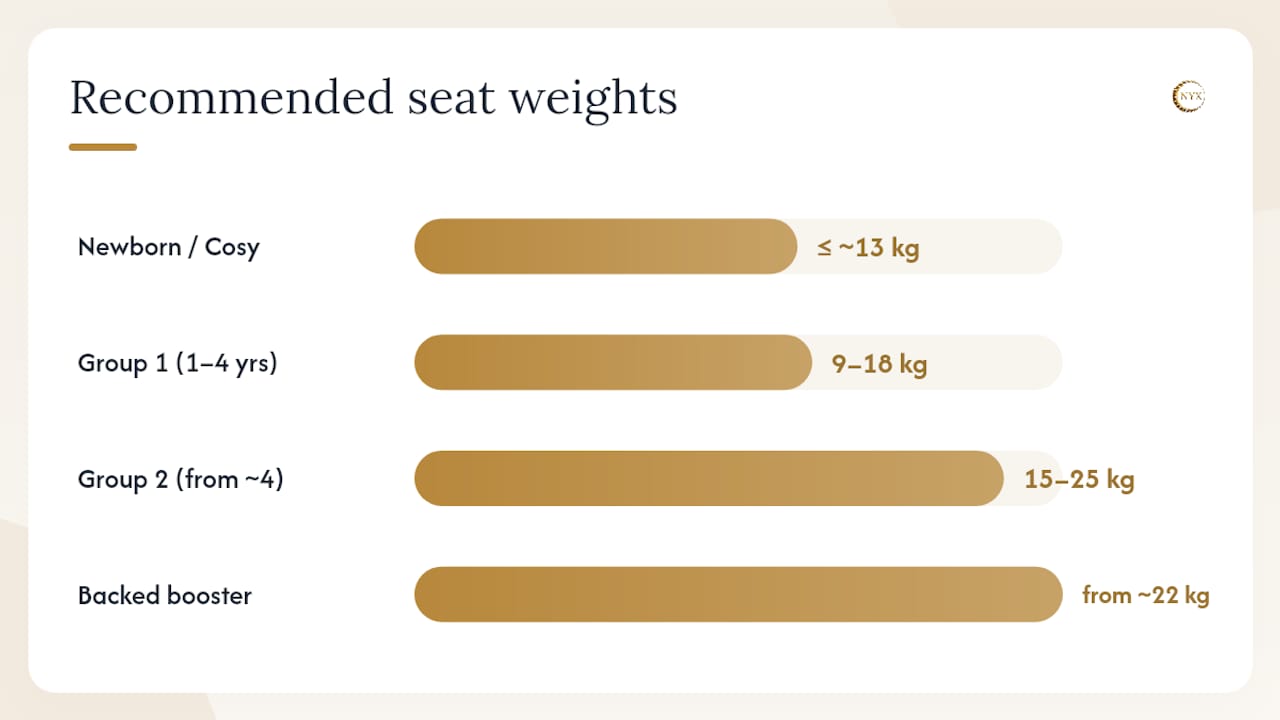
Two homologation standards govern the French market, and knowing the difference helps you ask for the right thing when you book. i-Size (R129) is the newer standard, built around the child's height rather than weight, and it mandates rear-facing travel until at least 15 months along with improved side-impact testing. ECE R44/04 is the older weight-based standard, still legal and still widely fitted, organised into weight groups from birth through to roughly 36 kg.
Pro Tip: When you book, give the driver both the child's age and their current weight or height, not just one. A seat rated correctly for weight can still be the wrong shape for an unusually tall toddler, and vice versa.
- Newborns to around 15 months (up to roughly 13 kg or 83 cm): a rear-facing "cosy" or "coque" seat, ideally i-Size rated.
- Roughly 9 to 18 kg, 1 to 4 years: a Group 1 seat, rear-facing where possible for as long as the child fits comfortably.
- Roughly 15 to 25 kg, from about 4 years: a Group 2 seat with a five-point harness or an integrated booster.
- From around 22 kg up to 10 years or 1.35 metres: a backed booster cushion (rehausseur), never a cushion alone if a backed option is available.
Correctly fitted restraints make a measurable difference to injury severity in a collision, which is precisely why Sécurité routière treats correct use, not just presence, as the safety benchmark. Where ISOFIX anchors are fitted in the vehicle, they remove much of the human error involved in strapping a seat in with a standard seatbelt, and most professional VTC fleets now carry ISOFIX compatible seats for exactly that reason.
Booking a VTC or taxi with a child: the steps that avoid a refusal at the kerb
- At the time of booking, state the child's exact age, height and weight, and specify the seat type you expect, whether that is a rear-facing infant seat, a Group 1 harness seat, or a booster.
- Confirm installation time is included in the reservation. A seat fitted properly takes a few minutes longer than simply opening the door, and a rushed installation is a false economy.
- At the vehicle, check the homologation label before your child gets in. It should be visible and legible, not worn smooth from age.
- Let the driver install the seat, then check the harness tightness yourself with the pinch test: you should not be able to pinch excess strap webbing at the shoulder.
- If no seat is available, your three real options are to supply your own seat, ask for a family-equipped vehicle such as a Van 7 pax or Van 8 pax, or cancel and rebook rather than travel without one.
Family-travel guides that cover this ground in more detail, such as Autour de bébé's rules and advice on VTC and taxi car seats, make the same point from a parent's perspective: the driver arriving without a seat is a foreseeable scenario, and the parent who has a backup plan loses less time. For a wider view of what to check before any Riviera booking, how to book a VTC transfer on the French Riviera covers the same handover checks in more depth.
Airport transfers with children: choosing the right vehicle and timing
Airport runs are where child seat logistics get complicated fastest, because you are also managing luggage, a flight schedule and often more than one child at once. A single sedan rarely has room for two child seats, a pushchair and four suitcases, which is why family-focused VTC operators steer parents toward larger vehicles for exactly this journey.
- A Van 7 pax or Van 8 pax gives enough floor space to fit two child seats alongside full-size luggage, without cramming a booster against a suitcase.
- Fixed per-vehicle 2026 rates mean the fare does not shift because you added a seat request or a second child, and flight monitoring on airport pickups absorbs the uncertainty of a delayed landing.
- Free waiting time, typically about an hour on airport pickups, gives enough margin for baggage claim, a nappy change, and unhurried seat installation before departure.
- Confirm seat availability when you book rather than at the gate. A driver who knows in advance can pre-install the seat before you clear arrivals.
What happens during a control, or after an accident
Roadside checks on child restraint use do happen, and enforcement in France applies to the driver as the person responsible for the vehicle's occupants, professional or private. A VTC driver carrying an unrestrained child under 10 without the taxi exemption is exposed in exactly the same way a private motorist would be.
- If you are involved in an accident, note the driver's name, VTC licence number and the platform used for the booking, alongside the vehicle registration.
- Photograph the seat as fitted, if it survived the collision, since this matters for both insurance and any safety review.
- Contact your own insurer and the platform's support line promptly, even for a minor incident.
- Whatever the legal exemption in play, the practical advice stays constant: a properly fitted, homologated seat is the single biggest factor in reducing injury severity for a young passenger.
From the chauffeur's seat: notes on family transfers along the coast
Preparing for a family run starts before the client ever sees the car. A driver checks the seat's homologation label, confirms the harness adjusts to the child's current size, and has it fitted before the family reaches the kerb, not after. On a Nice NCE to Monaco transfer, a journey of moderate length covering a coastal route, that preparation buys back the minutes a rushed installation would otherwise cost at pickup. The same applies on the longer run to Cannes, around half an hour depending on traffic conditions near the Croisette.
Booking ahead is what makes this possible. A driver who knows the child's age and weight the night before can have the correct seat, fixed to the fixed 2026 rate agreed at booking, ready before the family arrives.
— Dany
Family transfers with TranspOnyx: seats sorted before you arrive
Transponyx builds child seat requests into the booking itself rather than treating them as an afterthought, which is the gap that catches most families out with ad hoc VTC bookings. Specify your child's age and weight when you reserve, and the seat is fitted and checked before your flight even lands, backed by fixed 2026 rates that do not change because a Van 7 pax replaced a Standard Sedan.
Every airport pickup includes 60 minutes of free waiting time and full flight monitoring, so a delayed landing or a slow baggage hall never turns into a rushed, unsafe seat installation. Larger families or groups travelling with multiple children can move up to a Van 7 pax or Van 8 pax without losing the fixed-rate transparency that applies across the fleet, and every driver is bilingual in English and French at minimum. For families packing for a longer stay, PerfectHost's 2026 rental essentials checklist is a useful companion for what to bring beyond the car seat itself.
To book a family transfer from Nice Côte d'Azur Airport to Monaco, Cannes, Antibes or anywhere along the coast, call +33 6 10 30 71 84 and confirm your child's age and weight at the time of booking. That single detail is what lets the driver arrive with the right seat already fitted.
This article is general information, not a substitute for advice from a qualified lawyer. Consult a qualified legal professional about your own circumstances before acting on anything here.
Sources
- Service-public: transport d'enfant en voiture
- Article R412-2 - Code de la route
- Sécurité routière: transporter un enfant en voiture
FAQ
Does Uber provide a child seat?
Uber does not guarantee a child seat is present in every vehicle; availability depends on the individual driver, so parents should request one in advance through the app or book a service that confirms seat provision at reservation, such as Transponyx.
What does the current law say about car seats for children in France?
Article R412-2 requires every child under 10 to travel in a restraint homologated to i-Size (R129) or ECE R44/04, matched to their current height and weight, in any private vehicle including a hired VTC.
Is there a booster seat rule I should know for VTC or taxi trips?
A backed booster cushion is legal from around 22 kg up to 10 years or 1.35 metres, but Sécurité routière recommends a backed booster over a cushion alone whenever one is available.
What is the actual regulation for child car seats, VTC included?
The regulation ties the obligation to the driver as well as the parent: a VTC driver must ensure a compliant seat is fitted for any child under 10, and can refuse the trip if one is not available, while taxis retain a narrow historic exemption.
Can a VTC driver refuse to take my child without a seat?
Yes. A VTC driver is legally entitled to refuse the journey if no compliant, homologated seat is available for a child under 10, since VTCs are treated as private hire drivers under French law rather than under the taxi exemption.