

For a French national or EU citizen crossing into Italy for up to 90 days, a valid carte nationale d'identité or passport is sufficient. Non-EU nationals generally need a passport valid at least three months beyond their departure date and may need a visa. Whichever document you carry, check the expiry date and be ready to show proof of accommodation and a return ticket. Border staff can refuse entry even to travellers holding the right paperwork if these conditions aren't met.
Documents frontière Italie for short stays: CNI or passport?
French and EU citizens crossing into Italy for tourism, business, or family visits can use either their carte nationale d'identité or a passport, provided the stay stays within 90 days in any rolling 180-day period. Both documents carry equal weight at Italian border posts, whether you're driving through Ventimiglia or flying into Milan.
A passport still has practical advantages. If your trip extends beyond Italy into a non-Schengen country, or you're renting a car and the agency insists on passport-level identification, having one avoids awkward conversations at the counter. Airlines and train operators increasingly issue nominative tickets, meaning the name on your booking must match your ID exactly. Trenitalia's own guidance to passengers stresses checking travel documents before departure, a habit worth adopting whether you're catching the Nice to Ventimiglia regional service or boarding an Air France connection via Rome.
Before you leave home, run through a few checks:
- Confirm the photo still resembles you and the card or passport isn't cracked, delaminated, or water-damaged.
- Check the expiry date sits comfortably beyond your return, not just past it.
- For children, remember their identity documents carry shorter validity windows than adult ones.
- Match the exact spelling of your name across your ticket and your ID, including accents and hyphenated surnames.
Passport and ID validity: the technical rules that catch people out
Most refusals at Italian border control have nothing to do with fraud or suspicion. They happen because a passport fails a technical test the traveller never knew existed.
Under Schengen rules, a passport must show a date of issue less than ten years before arrival and remain valid for at least three months after the planned departure date from the Schengen area, according to UK government guidance on Italy's entry requirements. French passports renewed before 1 October 2018 sometimes carry an extended validity sticker that confuses this calculation, so check the printed expiry date rather than assuming an extra year automatically applies.
Quick reference:
- Adult French passport: issued within 10 years, valid 3+ months past departure.
- Children's identity documents: shorter validity periods than adult versions, so check separately.
- Hotels must register your passport details with police on arrival, per Italia.
- Not staying in registered accommodation? You must file a declaration of presence with the local questura within eight days.
Visas and long stays: when 90 days isn't enough
The 90/180 rule caps visa-free stays for French and EU citizens travelling within Schengen, but it only applies to short visits. If you're relocating, studying, or working in Italy for longer, you need to apply for a national visa before the 90-day allowance runs out, not after.
Depending on your purpose, you might encounter:
- A Uniform Schengen Visa (USV) for short stays across the zone, rarely needed by EU citizens.
- A Limited Territorial Validity (LTV) visa, restricted to Italy alone.
- A national long-stay visa (type D), required for study, work, or family reunification exceeding 90 days.
Applications begin at the Italian consulate covering your French region, or through the Italian Ministry of Foreign Affairs portal. Once you arrive, you'll need to lodge a declaration of presence and, for longer stays, visit the local Questura's Sportello Amico desk to begin your residence permit application within eight working days.
Crossing by car: what drivers must carry
Driving from Nice or Menton into Italy remains one of the simplest border crossings in Europe, but police still conduct spot checks, particularly around Ventimiglia during peak season.
- Carry a valid driving licence and identity document for every passenger, not just the driver.
- Bring the vehicle's registration certificate (carte grise), matching the car you're actually driving.
- Confirm your insurance certificate covers Italy. Hire cars usually include this automatically, but notify the rental company if you're crossing borders, since some policies exclude it by default.
- Fit child seats before departure. Italy applies its own safety equipment rules, and officers can and do check.
- Expect occasional temporary checkpoints, especially around major events, where police may ask for any of the above without warning.
Minors and unaccompanied children: what changes
Children's identity documents don't follow adult validity rules. French identity cards issued to under-18s carry shorter validity windows, often five years rather than ten, so check the expiry date separately from your own.
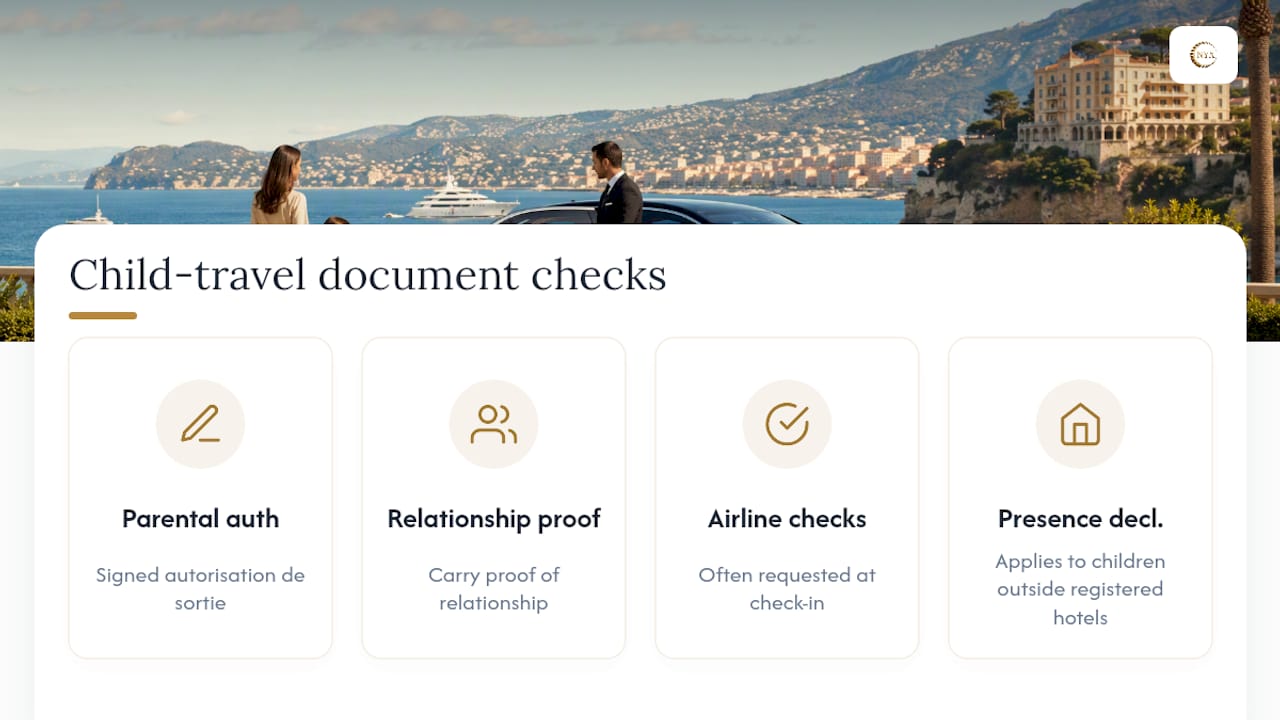
If a child is travelling with only one parent, or with grandparents, carriers and border guards can ask for a signed parental authorisation (autorisation de sortie du territoire) alongside proof of the accompanying adult's relationship to the child. This isn't universally enforced, but airlines increasingly request it at check-in. Families staying outside registered hotels should also remember the declaration of presence applies to children too, not just adults on the booking.
EES biometric checks: what to expect at the border
The Entry/Exit System is rolling out across Schengen borders, replacing manual passport stamping with biometric registration, fingerprints and a facial photo captured on your first crossing. GOV.UK's advisory notes this can extend processing time at airports and land crossings, particularly during the transition period.
Beyond your ID, officers commonly ask for:
- Proof of accommodation, a hotel confirmation or rental booking.
- An onward or return ticket.
- Valid travel insurance covering your stay.
- Evidence of sufficient funds for the trip.
If your EES record captures an error, ask the border officer to correct it on the spot rather than travelling on and disputing it later. Registration itself carries no charge, but it does add measurable queue time, worth building into your schedule around Nice Côte d'Azur Airport during busy departure banks.
Lost or stolen passport: what to do immediately
Losing a passport or identity card mid-trip is stressful, but the process to recover travel ability is straightforward if you follow it in order.
- Report the loss or theft to the nearest local police station and obtain a written police report, essential for every step that follows.
- Contact the nearest French consulate or embassy in Italy to request an emergency travel document, bringing the police report, a photo, and any secondary ID you still hold.
- Do not attempt to travel home on the police report alone. Airlines and border officials will not accept it as a substitute for a valid emergency travel document or renewed passport.
Pre-departure checklist: the 48 hours before you travel
Run through these checks two to three days before crossing, giving yourself time to fix anything that's out of order:
- Verify your CNI or passport's physical condition and expiry date.
- Save or print proof of accommodation and your return ticket.
- Confirm your travel insurance is active and covers Italy.
- If driving, check your vehicle registration and insurance certificate are in the car.
- Pack parental authorisation letters if a child is travelling without both parents.
- Add 30 to 45 minutes to your airport or port arrival time to account for EES processing.
- Carrying €10,000 or more in cash? You must declare it, since amounts above that threshold require formal declaration on entry or exit.
Pro Tip: Screenshot your accommodation confirmation and return ticket before you leave home. Mobile signal near border posts at Ventimiglia can be patchy, and a saved PDF beats a spinning loading icon in front of a queue.
A Riviera perspective on crossing into Italy
Crossing from Nice into Italy rarely takes long under normal conditions. The A8 run to Ventimiglia covers roughly 40 kilometres in under 40 minutes outside peak traffic, and Menton to the border adds barely ten minutes more. The picture changes entirely during the Monaco Grand Prix or the Cannes Film Festival, when road closures and event traffic push crossing times well beyond the usual window. Travellers heading to MIPIM in Cannes or MIPCOM season should build in an extra hour either way. TranspOnyx drivers cross this corridor daily and plan routes around exactly these fluctuations.
— Dany
Why TranspOnyx makes cross-border travel simpler
Sorting out documents frontière Italie paperwork is only half the job. Getting from Nice Côte d'Azur Airport to your Italian destination without hunting for parking, navigating an unfamiliar hire car, or worrying about insurance cover across the border is the other half, and it's where a fixed-rate chauffeur service earns its keep.
TranspOnyx runs fixed-rate 2026 transfers from Nice into Ventimiglia, Menton, and onward into Italy, with bilingual licensed drivers who know exactly what documentation checks to expect at the border and how to time crossings around events like the Monaco Grand Prix or Cannes Film Festival. Every booking includes flight monitoring, 60 minutes of free waiting time on airport pickups, and child seats on request, all in a Mercedes-Benz Standard Sedan, Business Sedan, Van 7 pax, or Van 8 pax depending on your party size. Rates are confirmed at booking with no surprises added later. If your itinerary runs further into Italy, the private transfer route to San Remo covers that leg with the same fixed pricing. Call +33 6 10 30 71 84 or book online at Transponyx to lock in your transfer before your next Riviera to Italy trip.
Sources
Rules change, so confirm the latest position directly with official channels rather than relying on secondhand summaries. France Diplomatie covers entry and residence advice for French nationals, while Service-public details identity document rules. For packing beyond paperwork, ReisLastMinute's Italy checklist is a useful practical companion.
FAQ
Can you cross the Italian border without an identity card?
No. French and EU citizens must carry either a valid carte nationale d'identité or a passport to cross into Italy, even for a short day trip. Border police can and do carry out spot checks, particularly at land crossings like Ventimiglia.
Who is affected by ETIAS rules when travelling to Italy?
ETIAS applies to non-EU, non-Schengen nationals who currently travel visa-free, not to French or EU citizens. French travellers using a CNI or passport are unaffected by ETIAS requirements when entering Italy.
What document is required to enter Italy from France?
A valid carte nationale d'identité or passport is required, with the passport needing at least three months' validity beyond your planned departure date under Schengen rules. Non-EU nationals should check separately whether a visa also applies to their situation.
How do you cross the Italian border by car?
Carry a valid driving licence, identity document, vehicle registration certificate, and proof of insurance covering Italy. Police occasionally run temporary checks at land crossings near Ventimiglia, so keep documents accessible rather than buried in luggage.
What happens if my passport is lost just before crossing into Italy?
Report the loss to local police immediately and obtain a written report, then contact the nearest French consulate to request an emergency travel document. A police report alone will not get you across the border or onto a flight home.