
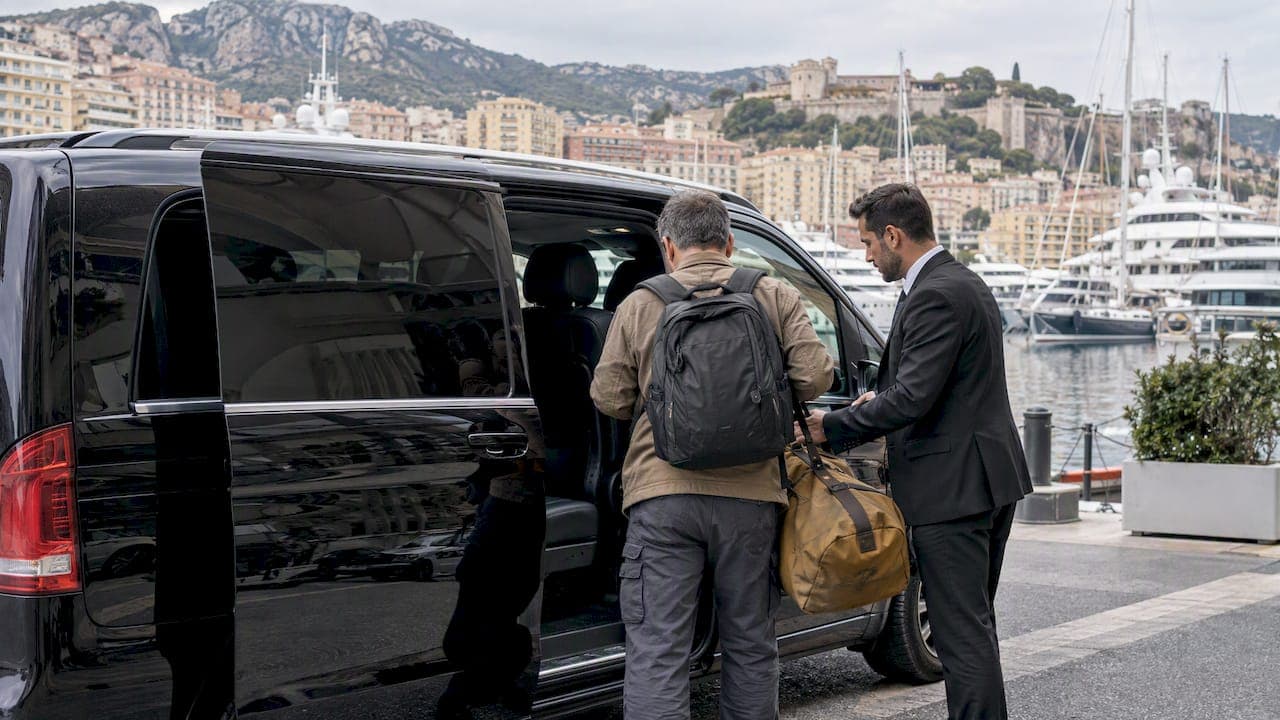
For most crew changes in Monaco, the practical answer is a pre-booked private vehicle between Nice Côte d'Azur Airport (NCE) and an agreed meeting point in the Principality. The airport is 22 km from Monaco and about 25 minutes by motorway in normal conditions. A fixed-rate Mercedes-Benz transfer from TranspOnyx for that run is priced at €90 to €140 per vehicle for 2026, confirmed at booking, with 60 minutes of free waiting on every airport pickup and flight monitoring included.
This guide is written for ship's agents, yacht managers, crewing departments and the seafarers themselves. It explains what a crew change transfer actually consists of, who must confirm what before a driver is sent, how road compares with rail and helicopter, and how to write a booking brief that leaves nothing to chance.
What a crew change transfer really involves
A crew change is rarely a simple lift from A to B. One person leaves a vessel after a rotation while another arrives to take the same post, and the two journeys have to meet in the middle without leaving the vessel short-handed. The International Maritime Organization describes crew changes as vital to prevent fatigue and protect seafarers' health, safety and wellbeing, which is why they cannot be postponed indefinitely and why the ground leg deserves as much planning as the flight.
In Monaco the ground leg has a particular shape. The Principality has no commercial airport of its own, so almost every joiner lands at Nice and travels east along the coast. Almost every leaver does the reverse, often with a flight home the same day. Between those two points sit baggage, a seabag or two, perhaps tool cases or personal protective equipment, and a vessel that may be alongside at Port Hercule, at anchor off the coast, or waiting for a berth that has not yet been confirmed.
That is the reason a taxi rank or a ride-hailing app is a poor fit. A seafarer arriving off a long-haul connection needs someone who knows which terminal, which arrival hall and which gate on the quay. A crew coordinator needs a name, a plate and a telephone number sent in advance. And nobody wants the driver to leave because a delayed flight ran past the booked time.
A transport quotation for a crew change should state clearly what it covers. The vehicle movement is only the base. Waiting time, a meet-and-greet in the terminal, help with luggage and contact with the agent are separate elements, and the IMO's guidance on crew changes stresses communication between employers, agents, ports, airports, airlines and authorities as the thread that holds the process together. Ask for each element in writing.
Who decides what: the agent, the authorities and the driver
A driver moves people. A driver does not clear them. This distinction saves a great deal of confusion on the day.
Monaco has its own Department of Maritime Affairs, which among other duties handles crew embarkation, professional-aptitude checks and the issue of crew lists. It is based at 20 quai l'Hirondelle, 98000 Monaco, and its listed administrative hours are 09:30 to 17:00, Monday to Friday. Anything involving crew-list discrepancies, seafarer licences or port authorisation belongs with the vessel's agent and those authorities, not with someone holding the car door at the kerb.
The sensible order of events is therefore this. The agent confirms the operational handover point and confirms that the seafarer is cleared to join or leave. Only then does the crewing office book the vehicle, passing on the confirmed pickup address, the person's name as it appears on their travel document, the flight number and a contact who will answer the telephone. Booking first and asking questions later is how a driver ends up outside the wrong gate with a passenger who has not yet been cleared to board.
A second point on hours. If the Department keeps office hours on weekdays, a Saturday night rotation still happens, because vessels do not keep office hours. That is where a service that runs around the clock matters. TranspOnyx operates 24 hours a day, seven days a week, so a joiner landing at NCE late on a Sunday is not left to improvise. The paperwork side, though, should be settled during the working week wherever possible.
Entry and health requirements also vary by nationality and itinerary. Much of the guidance still circulating online dates from the pandemic, when protocols on testing, distancing and temperature checks were part of every rotation. The IMO's FAQ belongs to that period, so do not copy it as a current checklist. Confirm current requirements for each traveller with the agent or the relevant consulate before the journey.
Road, rail or helicopter: choosing the right mode
Monaco's own access information sets out the options plainly, and each solves a different problem. The table below compares them from a crew coordinator's point of view.
| Mode | Typical journey, NCE to Monaco | Suits | Limits for a crew change |
|---|---|---|---|
| Private road transfer | About 25 minutes by motorway in normal conditions | Seafarers with checked bags or a seabag, groups, fixed meeting points | Subject to motorway traffic, particularly during major events |
| Train | About 25 to 30 minutes, with trains every 15 minutes at peak times | Lightly equipped travellers | Station interchange, stairs and a walk with all luggage |
| Helicopter | 7 minutes between Nice airport and Monaco Heliport | Senior officers and owners in a hurry | Cost, weather, and luggage restrictions that rarely suit seabags |
The rail journey is predictable and cheap, and for a deck officer arriving with one rucksack it is a reasonable choice. The Automobile Club de Monaco notes that Monaco is about 30 minutes from Nice by train, with services every 15 minutes, and 11 minutes from Menton. But a train does not collect anyone from the terminal, and it ends at the station, not at the quay. For a seafarer with a seabag, a heavy case and a connecting flight behind them, that last stretch is the hard part.
Road transport offers the one advantage that matters most in a crew change: a direct movement from an agreed ship-side or hotel meeting point to NCE, with no station interchange and no repeated handling of bags. For travellers who prefer the air, we also arrange helicopter transfers between Nice and Monaco, and the ground element at either end can sit in the same booking.
Journey times and distances that matter
Numbers help a coordinator build a schedule, so here are the ones worth using, and the caveats that go with them.
Nice Côte d'Azur Airport to Monaco is 22 km. In normal conditions the motorway run takes around 25 minutes. That is the figure to use for planning, but it is a floor, not a promise. Allow a further margin in the morning and evening peaks, and a much larger one in the weeks when the Principality fills up.
Menton lies a short hop further east. By train it is only 11 minutes from Monaco, which tells you how compact this stretch of coast is. Crews who join at Menton or at the Italian border, for example via Ventimiglia, are a regular part of our work, and the same fixed-rate logic applies. Our airport-to-Menton and Beausoleil transfer is priced from €108 to €158 per vehicle in 2026.
Two timings are easy to overlook. The first is the time between landing and leaving the airport: passport control, baggage reclaim and the walk to the pickup point. We monitor every airport arrival, so the driver tracks the actual landing time, not the scheduled one, and 60 minutes of waiting are included. The second is the time between the vehicle arriving at the quay and the person actually boarding, which depends on the agent and on port access. That one is outside the driver's control, which is why the pickup point and any access instructions must come from the agent.
When Monaco fills up: events and congestion
A crew change that takes 25 minutes on a quiet Tuesday can take far longer in the week of the Monaco Grand Prix. The Automobile Club de Monaco's own visitor guidance for the race lists train and bus alternatives and advises that road and station congestion should be allowed for during the event period. The same applies, with a different crowd, around the Cannes Film Festival, MIPIM, Cannes Lions and MIPCOM, when hotels, restaurants and roads along the coast are all running at capacity.
The yachting calendar adds its own pressure. When superyachts gather in the Principality, owners, guests and crew all move at once, and rotations are often brought forward or pushed back to fit charters. A transfer that has to catch a 07:00 departure from NCE should be booked against the worst-case journey time, not the best.
For these weeks we suggest agreeing three things with the vessel's agent in advance: the exact pickup point, an alternative pickup point if access is restricted, and a latest acceptable departure time from Monaco for each outbound flight. A driver who knows the approaches can avoid some friction, but the agent must still confirm access instructions and the authorised pickup point. Our guide to Nice airport transfers for Monaco events goes into the practicalities of the busiest weeks.
Vehicles and 2026 fixed rates
The TranspOnyx fleet is made up exclusively of Mercedes-Benz vehicles in four categories: the Standard Sedan and the Business Sedan, each for up to three passengers, the Van 7 pax and the Van 8 pax. All carry Wi-Fi, air conditioning, chilled water and phone chargers. A Business Sedan has a premium finish, which suits a chief engineer or a captain joining after a long flight, while a Van 7 pax or Van 8 pax is the logical choice when a full watch rotates together.
Rates are fixed per vehicle and confirmed at booking. There is no surge pricing, which matters when a flight is delayed or an event pushes demand up. The 2026 rates relevant to a Monaco crew change are these:
| Journey | 2026 fixed rate, per vehicle |
|---|---|
| Nice airport to Monaco Monte-Carlo | €90 to €140 |
| Nice airport to Menton and Beausoleil | €108 to €158 |
| Nice airport to Antibes and Juan-les-Pins | €68 to €110 |
| Nice airport to Cannes | €90 to €150 |
| By-the-hour hire | €60 to €90 per hour |
The hourly option is useful when a change is not a single transfer. A coordinator may need a vehicle to collect one seafarer from the airport, wait while paperwork is completed at the agent's office, take a leaver back to NCE and then collect the next joiner. In that case a booking by the hour, with the driver kept on call, is easier to manage than three separate transfers. The full list of airport routes and rates is on our airport transfer page.
Child seats are available on request, which matters less on a rotation than on a family holiday, but is useful when a seafarer is travelling with relatives. For those arriving from a cruise call, our cruise port transfer guide for Villefranche covers the neighbouring port.

How to brief a crew change booking
The quality of a transfer is decided by the quality of the brief. A coordinator who sends complete information once will save a dozen messages on the day.
Start with the person. The driver needs the traveller's full name as it appears on their passport, a mobile number that works abroad, and ideally a WhatsApp contact, because airport arrival halls are noisy and calls get missed. Add the flight number and the scheduled arrival time, since flight monitoring depends on it, and say whether the traveller has checked baggage or a seabag so the right vehicle is sent.
Then the destination. Give the vessel's name, the berth or anchorage if known, and the agent's name and telephone number. State plainly whether the agent has confirmed access. If the handover is at a hotel and not at the quay, give the hotel's name and the check-in or room arrangements, so the driver is not waiting at the wrong door.
Then the scope. Say whether you want a simple pickup, a meet-and-greet inside the terminal with a name board, help with luggage, or a combined return leg. Our explanation of baggage assistance sets out what that can include. A joiner arriving from a long rotation with two heavy bags benefits from it far more than a traveller with a carry-on.
Finally, the contingencies. A missed connection, a flight diverted to another airport or a vessel that changes berth at the last minute are all part of the trade. Name a person who can authorise a change, and tell us the time after which the booking should be treated as cancelled. Our airport transfer checklist covers much of this and is worth sharing with crewing staff.
Our perspective on crew change transfers
We have driven enough arrivals at Nice Côte d'Azur to know that the vehicle is the easy part. What decides whether a rotation runs well is the information that reaches the driver before the aircraft touches down.
The most common problem we see is not lateness, it is ambiguity. A booking that says "Monaco, port" is not a pickup point. Port Hercule has more than one approach, and the agent is the only party who can say which is authorised on the day. So we ask for the agent's contact at the time of booking and we treat the agent's instruction as final. We do not promise to resolve immigration or crew-list questions at the kerbside, because we cannot and should not. What we can do is make sure the person arrives at the right place, on time, rested as far as a journey allows, with their luggage and without a surprise bill.
The second lesson is about people. A seafarer finishing nine months at sea and heading home does not want a conversation, or perhaps wants a great deal of one. Our drivers are licensed VTC professionals, bilingual in English and French at a minimum, and some speak Italian, Spanish, Russian or Arabic, so a crew with mixed nationalities is not left to guess. Water is in the vehicle, the phone can charge, and the Wi-Fi works for the message home.
The third lesson is about price. Crewing budgets are scrutinised, and a variable fare that doubles when a flight is late is the kind of surprise a finance office dislikes. Fixed rates per vehicle, confirmed at booking, remove it. Where we think a client has chosen a less suitable arrangement, we say so: a single traveller with one bag and hours to spare can take the train perfectly well, and we would rather tell them than sell a transfer they do not need.
— Dany
Booking with TranspOnyx
If you manage rotations on the Riviera, you can reserve a fixed-rate Nice airport to Monaco transfer online, or speak to the reservations team on +33 6 10 30 71 84, or on WhatsApp at +33 7 67 78 10 26. The line is staffed around the clock. Details of the vehicles are on the fleet page, and agencies and yacht managers looking for a regular arrangement can find us at transponyx.com.
Frequently asked questions
How long does a transfer from Nice airport to Monaco take for a crew change?
In normal conditions the road journey takes about 25 minutes over 22 km, according to Monaco's official access information. Plan for a longer margin during major events such as the Grand Prix. Our drivers monitor your flight, so the pickup follows the actual landing time.
Can a driver arrange port access or clear a seafarer to board?
No. Port access, crew lists and clearance are matters for the vessel's agent and the relevant authorities, including Monaco's Department of Maritime Affairs. The driver collects the traveller and delivers them to the pickup point the agent has confirmed. We therefore ask for the agent's contact when you book.
How much does crew change transport from Nice airport to Monaco cost in 2026?
Our 2026 fixed rate for Nice airport to Monaco Monte-Carlo is €90 to €140 per vehicle, confirmed at booking. There is no surge pricing. By-the-hour hire, useful for multi-leg rotations, is €60 to €90 per hour.
What happens if the flight is delayed?
We monitor every airport transfer, and 60 minutes of waiting are included on airport pickups. The driver adjusts to the real arrival time, and the agreed rate stays the same. If a delay is likely to be long, tell us and we will agree the plan with you.
Can you take a whole watch or team together?
Yes. The Van 7 pax and Van 8 pax carry larger groups, and several vehicles can be coordinated for a bigger rotation. Give us the number of travellers, their flight numbers and the amount of luggage when you book.