
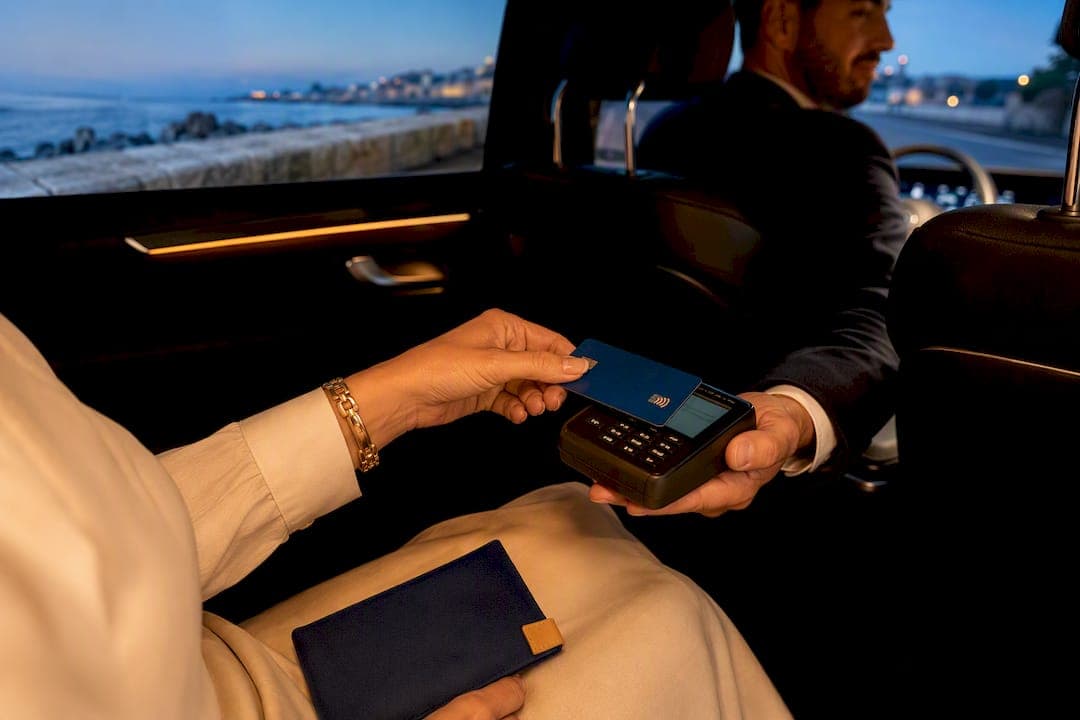
Licensed French taxis must accept card payment with no minimum fare, full stop. Prebooked chauffeur services typically settle payment online before the journey even begins. If a driver refuses your card, note the licence number, ask for a written invoice, and report the refusal to the DGCCRF or your local prefecture. Keep every booking confirmation, and where reliability matters most, choose a prepaid transfer.
Card payment chauffeur France: what the law actually requires
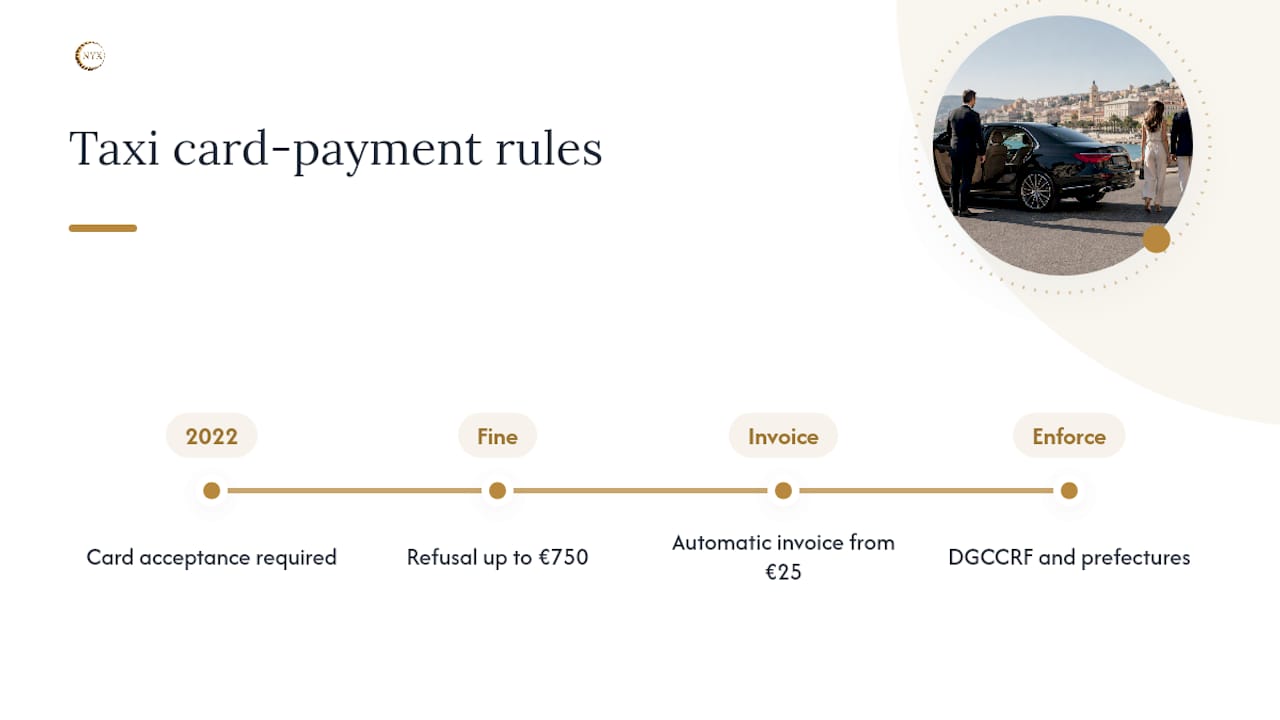
The obligation is not a courtesy. Since 1 July 2022, every licensed taxi operating in France must accept card payment regardless of the fare amount, a rule set out clearly in Service‑Public's guidance on taxi payment obligations. A driver cannot tell you the card machine "isn't working today" and demand cash instead, at least not lawfully. Refusal exposes the driver to fines of up to €750, and the terminal has to be in genuine working order, not just present in the vehicle.
The statutory basis sits within France's transport code, and readers wanting the primary legal text can consult the relevant Legifrance statutory provisions directly. Beyond accepting the card, drivers owe passengers a functional payment process and a proper receipt. Service‑Public specifies that an invoice must be generated automatically once the fare reaches €25 including tax, a threshold that matters for anyone claiming expenses. Enforcement runs through the DGCCRF (France's consumer protection authority) and local prefectures, both of which handle complaints against taxis operating under an ADS licence. The rule protects the passenger, not the driver's preference for cash.
Which cards and contactless wallets actually work
Expect the basics to work almost everywhere. According to TaxiNeo's guide to paying by card in a French taxi, licensed taxis must accept CB (the French Carte Bancaire scheme), Visa and Mastercard. Contactless payment, Apple Pay and Google Pay are increasingly common, but acceptance depends entirely on the individual terminal and how the driver's bank has configured it, not on the law itself.
A few practical habits avoid awkward moments kerbside:
- Ask before boarding whether contactless or a phone wallet will work, particularly late at night when a driver's connectivity might be patchy.
- Carry a physical chip card as backup, since NFC readers occasionally reject a phone wallet even when the card itself works fine.
- Keep any airline, hotel, or booking confirmation to hand if your journey was prepaid, since that document doubles as proof of payment terms.
- Industry technical notes on contactless implementation for vehicle operators confirm that terminal age and merchant bank settings, not the card network, usually explain why NFC fails intermittently.
What to do if a driver refuses your card
Refusal is illegal, but it still happens, usually blamed on a "broken" terminal. Three steps preserve your position and give the authorities something to act on.
- Record the vehicle and licence details. Note the registration plate and the driver's ADS licence number, and photograph both if it is safe to do so.
- Insist on documentation. Ask for an invoice or receipt, and state plainly that you intended to pay by card and are not obliged to hand over cash instead, a point The Connexion's coverage of card payment refusals confirms explicitly.
- Report it. Send the licence number, date, and any photos to the DGCCRF or your local prefecture.
Enforcement happens after the fact, so a report will not get you a working card machine there and then. That single limitation is why prepaid, prebooked journeys remain the more dependable route for anyone who cannot afford the risk.
Street taxis versus prebooked VTC: why the payment route matters
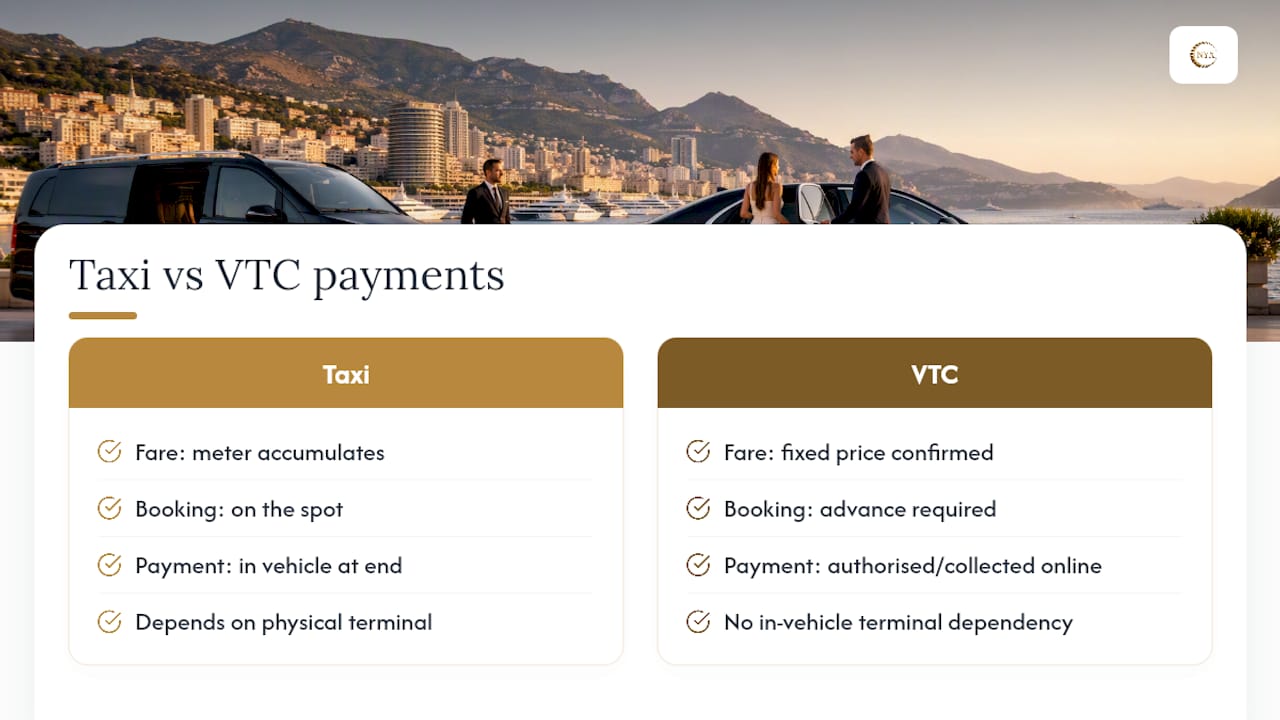
A metred street taxi and a prebooked VTC (voiture de tourisme avec chauffeur) solve the same problem, getting you from A to B, but they handle money very differently. A taxi's fare accumulates on the meter, and payment happens in the vehicle at the end, which means you are relying on a physical terminal working correctly at that exact moment. Even with the 2022 mandate in force, a broken reader or a driver claiming technical trouble remains, in practice, the most common cause of card disputes.
VTC services operate on a different model entirely. As Paris Je t'Aime's overview of chauffeur-driven vehicles explains, VTC firms are private companies that require advance booking and typically confirm a fixed price before the journey starts. Payment is usually authorised or collected online, which removes the in-vehicle terminal from the equation altogether. You can read more about how the two models diverge operationally in this comparison of taxi and VTC differences.
That distinction becomes practical rather than academic during Riviera peak periods. A traveller landing at Nice Côte d'Azur Airport during the Cannes Film Festival or arriving for the Monaco Grand Prix weekend faces taxi ranks under serious pressure, terminals working overtime, and drivers juggling volume. A confirmed, prebooked fare with payment already settled removes that entire layer of uncertainty, along with the awkward haggling that can accompany a broken card reader at 11pm.
How prepayment and invoicing work when you book in advance
Most professional chauffeur bookings follow one of two payment structures: full prepayment at the time of booking, or a card authorisation hold released once the journey is complete. Corporate accounts often add a third option, a proper invoice issued after travel, useful for expense reporting.
Whichever structure applies, the €25 invoice threshold that governs street taxis is a useful benchmark for business travellers requesting VAT-compliant receipts, since any fare above that level should generate one automatically under the same Service‑Public rules that cover taxis. Before confirming a booking, check four things: the cancellation and refund policy, how much waiting time is included before extra charges apply, whether the card is charged immediately or only once the journey finishes, and whether a formal invoice will follow automatically or needs requesting. A step-by-step guide to booking a VTC transfer on the Riviera walks through exactly this process for travellers unfamiliar with French chauffeur norms.
TranspOnyx in practice: removing card‑payment uncertainty on the Riviera
Transponyx confirms fixed 2026 rates at the point of booking, across all four fleet categories: Standard Sedan, Business Sedan, Van 7 pax and Van 8 pax. Payment is taken securely online, with invoices available for business clients, so there is no dependency on an onboard terminal working correctly at journey's end.
Every driver is a licensed VTC professional, bilingual in English and French at minimum. Pickups at Nice Côte d'Azur Airport include flight monitoring and 60 minutes of free waiting time, which matters far more than it sounds during a delayed arrival with luggage in hand. Reservations run around the clock through +33 6 10 30 71 84 or Transponyx. Fixing the price and settling payment before the driver even arrives eliminates the single failure point that causes most card disputes: a terminal that will not cooperate at the exact moment you need it to.
The most reliable route for travellers who need payment certainty
Prebooking a reputable chauffeur is the sounder choice whenever price certainty and a proper invoice matter, airport transfers, event travel, and any journey where an expense claim will follow. If you do end up in a street taxi, note the licence number as a matter of habit and report any card refusal to the DGCCRF without hesitation; it is a right, not a favour. For Riviera travellers who would rather settle payment before the journey starts, Transponyx offers a dependable local alternative built around prepaid cards and confirmed invoices.
— Dany
Booking Transponyx: fixed 2026 rates and secure card payment
Transponyx is the alternative to the terminal-and-hope approach that street taxis still rely on. Every fare is confirmed as a fixed 2026 rate before you travel, charged securely online, and backed by an invoice on request, so there is no card machine to fail and no cash to fumble for at Nice Côte d'Azur Airport or after a long evening in Cannes.
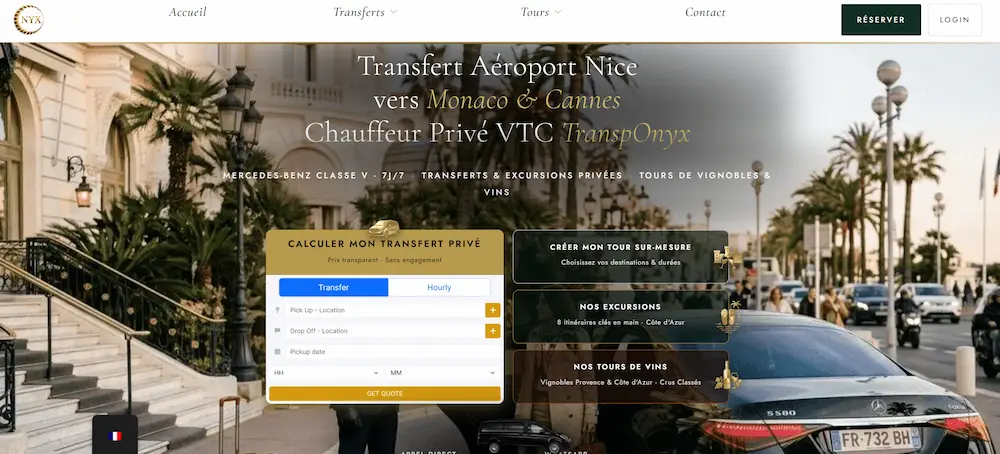
Whether you need a private driver across the French Riviera, a chauffeur for a Cannes event transfer, or a van for a family arriving from Antibes, the payment process is settled before the driver even leaves the depot. Call +33 6 10 30 71 84 or visit Transponyx to check availability and confirm your fixed rate for 2026.
Sources
- Service‑Public — Taxi payment obligations (F22127)
- The Connexion — Can French taxi drivers refuse card payments?
- Legifrance — statutory text
FAQ
Do French taxis take card payments?
Yes. Since 1 July 2022, every licensed French taxi must accept card payment regardless of the fare amount, and refusal can lead to fines of up to €750.
Can I use contactless payments in France?
Contactless, Apple Pay and Google Pay work in most modern taxis and VTC vehicles, though acceptance depends on the driver's terminal model rather than any legal guarantee.
Do I need to pay a vignette in France?
The vignette (a windscreen sticker) is a separate matter, generally tied to older vehicle emissions zones in certain cities, and it has no bearing on how you pay for a taxi or chauffeur fare.
Is it better to use cash or card in France?
Card is the more reliable option for taxis and chauffeurs, since it is legally required, generates an automatic invoice above €25, and avoids the need to carry large amounts of cash; prebooked services like Transponyx settle payment online before the journey, removing terminal risk entirely.